
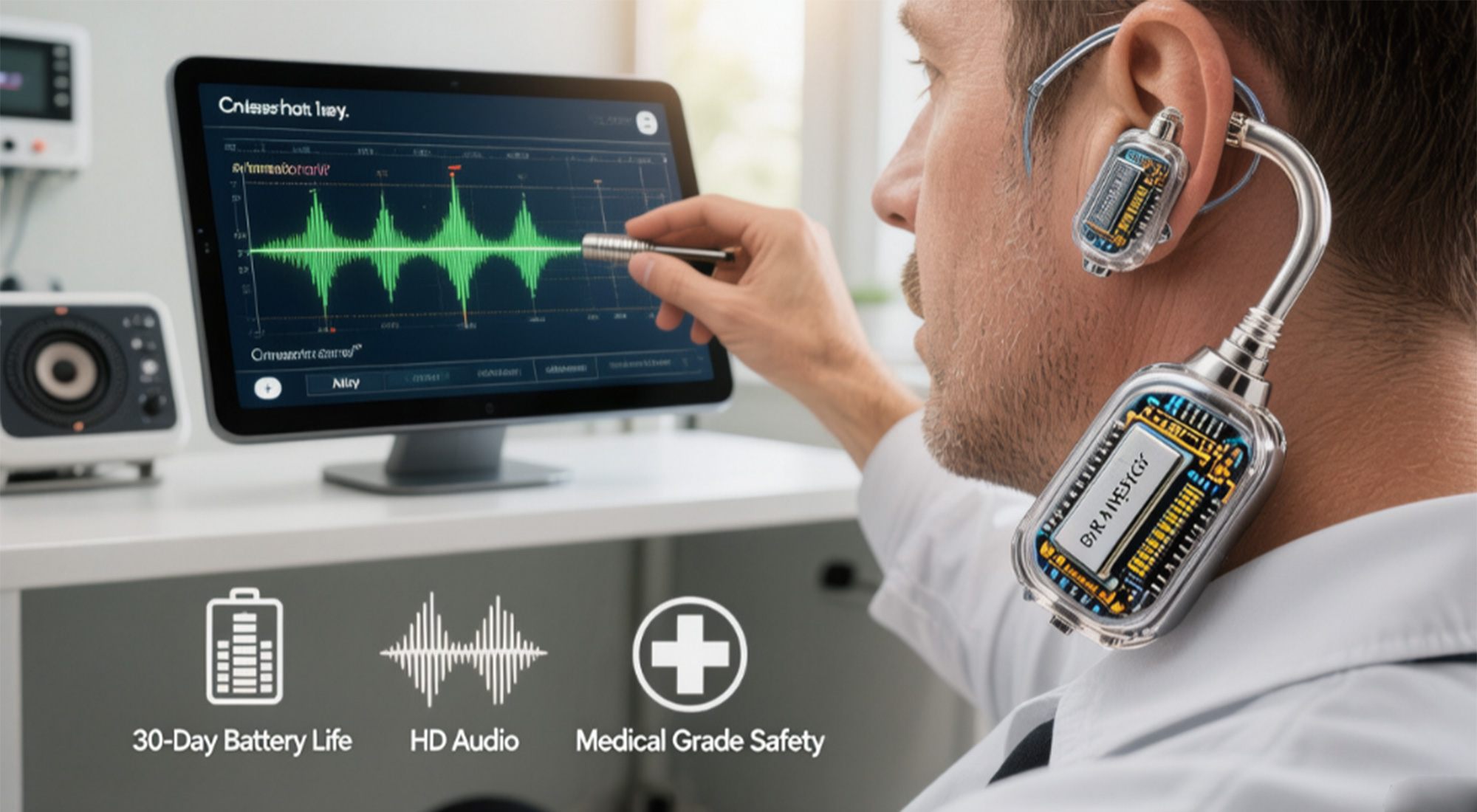
Powering Modern Bone-Conduction Hearing Devices: How LiPo and Cylindrical Lithium Batteries Enable the Next Generation of Hearing Technology
Custom LiPo and micro cylindrical lithium battery solutions for compact, safe and long-runtime bone-conduction hearing devices and open-ear audio wearables.
Industry Background: From Hearing Aids to Smart Bone-Conduction Devices
Bone-conduction hearing devices have grown rapidly with the advancement of hearing-assistive and wearable audio technology.
Unlike traditional air-conduction hearing aids, these devices transmit sound vibrations directly through the skull, bypassing
the ear canal and eardrum. :contentReference[oaicite:0]{index=0}
With Bluetooth LE Audio, AI noise reduction, enhanced vibration drivers, and
low-latency DSP processing, modern bone-conduction devices are evolving into high-performance smart wearables.
This evolution significantly increases energy demands and sets higher requirements for the internal battery system.
As a result, LiPo lithium polymer batteries and micro cylindrical lithium cells have become
critical components of next-generation open-ear audio products. They must deliver:
- All-day runtime in a very compact form factor
- Stable voltage for audio and AI algorithms
- High safety for long-hour skin contact
- Custom shapes that match ergonomic designs
For brands targeting sports, medical, or consumer audio markets, working with a professional
custom lithium polymer battery
partner is key to turning industrial design concepts into mass-producible products.
Key Power Challenges in Bone-Conduction Hearing Devices
Engineers and procurement teams face several battery-related challenges when designing bone-conduction hearing devices: :contentReference[oaicite:1]{index=1}
- High Power Consumption from Vibration Transducers
Bone-conduction drivers require continuous high-power output to generate sufficient vibration amplitude. This demands
batteries with strong discharge capability, consistent power delivery, and the ability to support full-day runtime
without noticeable performance drop. - Compact Device Structure & Flexible Battery Sizes
Headbands, ear hooks, and glasses-style frames all offer very limited internal space. Batteries must be ultra-thin, lightweight,
mechanically robust, and available in a wide range of custom sizes to match different industrial designs. - High Safety for Long-Hour Skin Contact
As these devices are worn for hours at a time, often in direct contact with skin, the battery must provide excellent thermal
stability, multi-layer protection (over-charge, over-discharge, short-circuit), and compliance with standards such as
UN38.3 and IEC 62133. - Dependence on Stable Voltage Output
Voltage instability may cause Bluetooth dropouts, AI algorithm failure, processing delays, or unstable vibration amplitude,
directly impacting user experience. - Convenient & Safe Charging Requirements
Users now expect USB-C, magnetic charging, or charging cases/bases. Batteries must integrate safely with these systems and
support frequent partial charging.
Why LiPo & Cylindrical Lithium Batteries Are Ideal
To solve these challenges, modern bone-conduction hearing devices typically use a combination of LiPo lithium polymer
batteries and micro cylindrical lithium cells. :contentReference[oaicite:2]{index=2}
- LiPo Lithium Polymer Batteries
Ultra-thin, lightweight, and highly customizable in length, width, and shape. Perfect for curved or ergonomic product
structures such as headbands and open-ear glasses. - Micro Cylindrical Lithium Cells
Strong metal housing for mechanical durability, higher discharge capability, and higher volumetric energy density in
certain layouts. - Stable Voltage Curve
Both LiPo and cylindrical lithium chemistries provide relatively flat discharge curves, which ensures stable DSP operation,
Bluetooth connection, and consistent vibration output. - Multi-Layer Safety Design
When paired with appropriate PCM/BMS, these batteries provide over-charge, over-discharge, over-current, short-circuit,
and temperature protection suitable for long-hour skin-contact wearables. - Rechargeable & Environmentally Friendly
Compared with primary cells, rechargeable lithium packs reduce waste and support sustainable, long-term device usage.
LiPo vs. Micro Cylindrical Lithium Cells in Bone-Conduction Devices
| Battery Type | Typical Shape | Key Advantages | Typical Use Inside Device |
|---|---|---|---|
| LiPo Lithium Polymer | Flat, thin pouch | Ultra-thin, flexible sizing, lightweight | Headbands, ear hooks, glasses arms |
| Micro Cylindrical (e.g., 10180 / 10220 / 10440) | Small metal cylinder | High discharge rate, strong housing, high volumetric energy density | Modules that need extra mechanical robustness |
For extremely slim or curved structures, PKNERGY also offers
ultra-thin battery solutions for wearables
, which are specifically optimized for open-ear audio and health-monitoring devices.
Technical Insights: LiPo, Micro Cylindrical Cells & PCM/BMS Design
1. LiPo Lithium Polymer Batteries
- Typical thickness: 3–6 mm
- Nominal voltage: 3.7 V
- Discharge rate: 0.5C–3C
- Cycle life: 300–800 cycles depending on usage and C-rate
- Supports curved or irregular custom shapes for ergonomic devices
2. Micro Cylindrical Lithium Cells (e.g., 10180, 10220, 10440)
- Metal housing provides strong mechanical durability
- High discharge capability to drive powerful vibration transducers
- Higher energy density compared to LiPo of the same footprint
- Suitable for modules where extra robustness is required
3. PCM/BMS Integration for Safety & Smart Charging
A complete bone-conduction hearing device battery module usually integrates:
- Over-current protection
- Over-voltage and under-voltage protection
- Short-circuit protection
- NTC temperature detection
- Compatibility with USB-C, magnetic charging, or charging bases
For devices that fall into medical or quasi-medical categories, PKNERGY’s battery designs can be aligned with
Medical Device Power Solutions
, considering more stringent safety, verification, and documentation requirements.
Typical Application Scenarios
LiPo and micro cylindrical lithium battery packs for bone-conduction devices are widely used in: :contentReference[oaicite:3]{index=3}
- Hearing Assistance for Conductive Hearing Loss
- Sports & Outdoor Audio (running, cycling, hiking with open-ear listening)
- Children’s Auditory Rehabilitation
- Professional Communication Environments (industrial, security, and mission-critical teams)
- Entertainment & Daily Commuting
Many bone-conduction hearing devices are essentially a cross-over between medical assistance and
consumer electronics power solutions
, requiring both comfort and long-term reliability.
PKNERGY Custom Battery Solutions for Bone-Conduction Devices
As a custom battery manufacturer, PKNERGY supports companies developing bone-conduction hearing devices and smart open-ear
audio products with:
- Custom LiPo Battery Packs
Tailor-made thickness, length, width, and tabs to fit headbands, glasses frames, or ear-hook designs. - Micro Cylindrical Lithium Modules
High-drain Li-ion cells and modules for powerful, long-lasting vibration drivers. - High-Drain Li-ion Solutions
Battery configurations optimized for continuous output and fast transient response. - PCM/BMS Design & Integration
Multi-layer safety, temperature monitoring, and compatibility with USB-C, magnetic charging, or docking bases. - Certification & Regulatory Support
UN38.3, IEC 62133 and related documents for transportation, regulatory filing, and market entry.
For projects exploring emerging chemistries or ultra-long cycle life, PKNERGY can also evaluate
sodium-ion battery customization
and other advanced technologies to support your future product roadmap.
FAQ: Battery Design for Bone-Conduction Hearing Devices
1. How do I choose between LiPo and micro cylindrical batteries?
If your design prioritizes ultra-thin, curved, or very lightweight structures, LiPo is usually the best choice.
If you need higher mechanical strength or higher discharge capability in a small cylindrical volume, micro cylindrical
cells may be more suitable. PKNERGY can compare both options based on your 3D design and power profile.
2. What capacity is typically needed for all-day bone-conduction hearing?
It depends on your driver power, DSP load, and wireless profile. Many devices target 6–12 hours of mixed usage.
By analyzing your average and peak current, PKNERGY can calculate the capacity and cell configuration required to meet
your runtime target with reasonable safety margin.
3. Are these batteries safe for long-hour skin contact?
Yes, when properly designed. PKNERGY uses LiPo and Li-ion cells with strong safety records and integrates PCM/BMS
with over-charge, over-discharge, over-current, and temperature protection. Mechanical design and insulation are also
considered to maintain safe surface temperature.
4. Can PKNERGY support USB-C or magnetic charging solutions?
Yes. Our engineering team can cooperate with your electronics designers to ensure that the battery, PCM/BMS, and
charging interface (USB-C or magnetic) work safely and efficiently together.
5. What information do you need to start a custom battery project?
We recommend sharing your mechanical drawing, target runtime, voltage/current requirements, expected usage pattern,
safety/certification needs, and estimated annual volume. With this information, PKNERGY can quickly propose a customized
battery solution for your bone-conduction device.
Contact Miah — PKNERGY
If your company is developing bone-conduction hearing devices or smart open-ear audio products, PKNERGY can support you
with custom LiPo batteries, cylindrical lithium cells, high-drain Li-ion modules, and PCM/BMS integration. :contentReference[oaicite:4]{index=4}
- Name: Miah (崔娟)
- Company: PKNERGY
- Email: sale@pknergy.com
- WhatsApp: +86 139 0246 3897
- Website: https://pknergybattery.com
You can also follow PKNERGY on:
YouTube,
LinkedIn,
X (Twitter),
Facebook,
TikTok.
Or submit your project details via our
Contact Us page and our team will reply soon.