
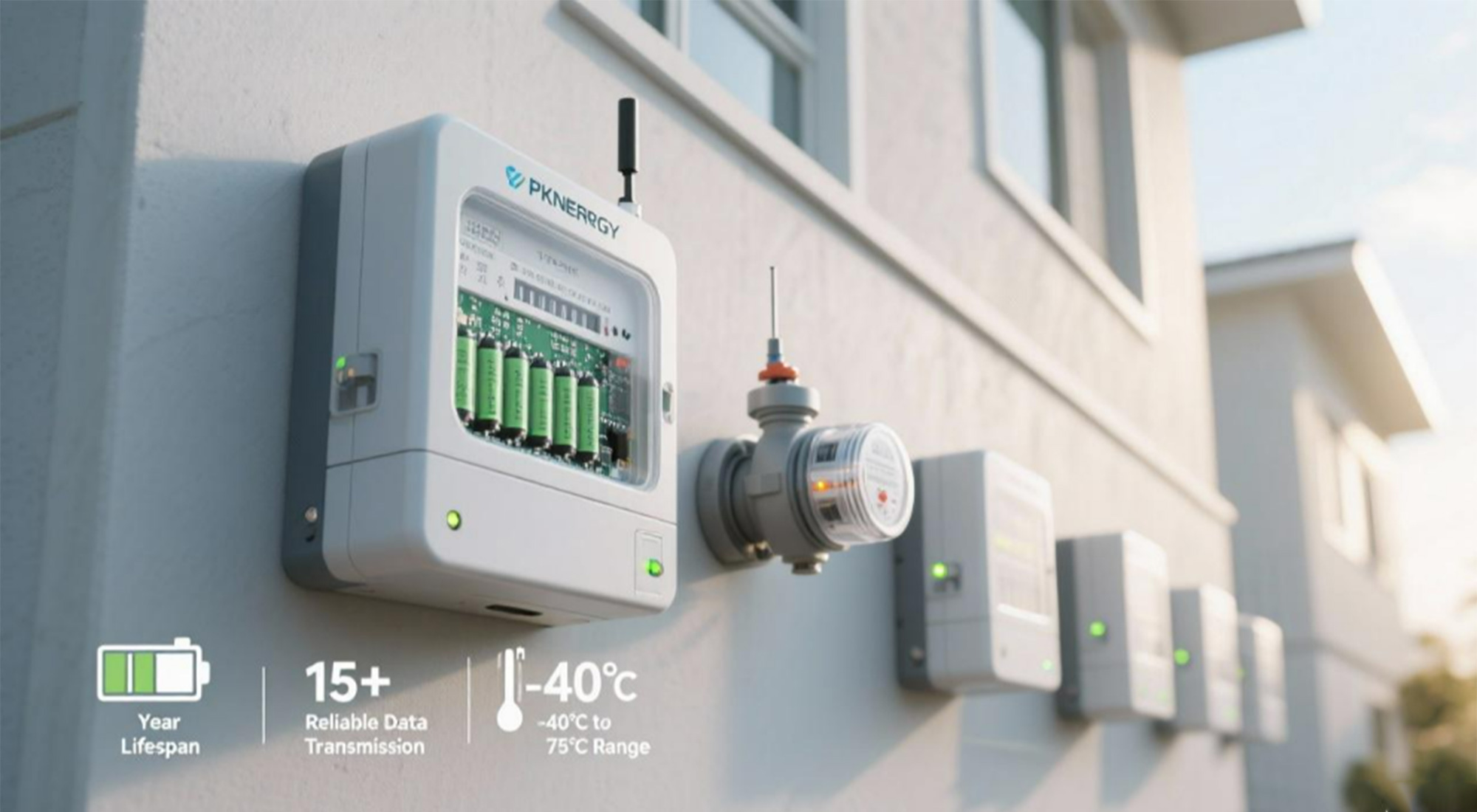
Powering Smart Water, Electricity & Gas Meters: Why High-Performance Lithium Batteries Matter
As cities move toward digital utilities and intelligent monitoring, the choice of lithium battery directly shapes
the lifetime, reliability, and maintenance cost of smart water, electricity, and gas meters.

01 | Power Characteristics of Smart Utility Meters
As cities accelerate toward digital utilities and intelligent monitoring, smart water, electricity, and gas
meters have become essential IoT nodes in modern infrastructure. These devices may appear simple on the outside,
but their long-term stability, communication performance, and maintenance cost heavily depend on one core
component: the battery. :contentReference[oaicite:0]{index=0}
For engineers, R&D teams, and procurement specialists, selecting the right battery technology directly
impacts product lifecycle, reliability, and field deployment success.
Smart meters share a unique set of operating behaviors:
Ultra-low standby current (µA-level)
Most of the time, the device remains in deep-sleep mode, waking only during measurement, reporting, or valve
actuation.
High pulse current during transmission
NB-IoT and LoRa communication often require instantaneous bursts above 500 mA, creating a challenge for
ordinary batteries.
10–15+ years service life requirement
Field maintenance is costly; long cycle life and low self-discharge are crucial, especially in large-scale
deployments across cities and industrial parks.
Harsh outdoor environments
Humidity, cold winters, and long-term exposure demand robust battery chemistry and packaging, including proper
sealing and wide-temperature performance.
These requirements make advanced lithium batteries the most suitable choice for smart metering applications.
When space or structure is highly constrained, PKNERGY can design
custom lithium polymer batteries;
for ultra-long life and safety-critical infrastructure, we may also evaluate
custom LiFePO4 battery packs or
wide-temperature stacked cells.
02 | Why Lithium Batteries Dominate Smart Metering
Different meter designs favor different battery form factors, but in almost all mainstream projects, lithium
technology has become the default due to its high energy density, long service life, and stable performance
under pulse loads.
1. LiPo (Lithium Polymer) Batteries — Compact & Flexible
- Ultra-thin, lightweight form factors
- Very low self-discharge
- Available in highly customizable shapes
- Supports stable peak current for communication modules
Ideal for: compact NB-IoT modules, space-limited water or gas meters where every millimeter in the enclosure
matters. For these projects, PKNERGY leverages its experience in
ultra-thin battery for wearables
to optimize cell thickness and footprint.
2. INR 18650 / 21700 Cells — High Density & Strong Pulse Performance
- Higher capacity (2600–5000 mAh)
- Excellent discharge performance
- Long cycle life (800–1500 cycles)
- Rugged cylindrical housing suitable for outdoor environments
Best for: valve-control gas meters, high-frequency communication meters, industrial metering, and applications
where stronger mechanical robustness is needed (e.g., pipeline installations or vibration-prone locations).
When required, we can also pre-study future platforms based on sodium-ion or other chemistries, leveraging our
experience in custom sodium-ion battery
solutions for IoT and industrial devices.
03 | Technical Pain Points in Real Projects
Across meter manufacturers, engineering teams frequently face challenges such as:
- Voltage sag during NB-IoT peak transmission
- Severe capacity loss in winter (low-temperature impact)
- Battery life failing to match device lifespan
- Tight structural constraints for battery fitment
- Inconsistent cell quality affecting communication reliability
These are exactly the issues PKNERGY focuses on optimizing through cell selection, pack design, and strict
quality control. Similar technical requirements also appear in our
Security Devices Power Solution
and Portable Detection Device Power Solution, where low power, long life, and high reliability are equally
critical.
04 | What PKNERGY Delivers for Smart Metering Projects
PKNERGY works closely with smart meter OEMs, module suppliers, and system integrators to turn metering power
requirements into robust, mass-producible lithium battery solutions.
A. Pulse-Current Optimization
Our lithium cells maintain a stable voltage plateau during communication bursts, preventing device resets or
packet loss. We match cell chemistry, pack wiring, and PCM/BMS parameters to real NB-IoT or LoRa peak current
profiles measured from your meter firmware.
B. Enhanced Low-Temperature Performance
Cell chemistry optimization enables reliable output even at 0 °C to −10 °C, ideal for
outdoor or pipeline-installed meters operating through cold winters. For extremely wide temperature ranges,
PKNERGY can also leverage experience from its
ultra-wide temperature stacked battery solutions.
C. Full Customization Capability
We provide customized solutions including:
- Dimensions tailored to meter housing (LiPo pouch or cylindrical pack)
- JST/PH/SM connectors and wire gauge options
- PCM/BMS protection circuits (OVP, UVP, OCP, SCP, NTC, etc.)
- Capacity matching per project lifecycle target (e.g., 10–15+ years)
- Labeling, harness routing, and insulation design to simplify assembly
D. Strict Consistency & Lifetime Quality Control
Every batch undergoes internal resistance screening, full capacity testing, and long-term environmental
simulations (humidity / temperature cycles). These measures ensure that batteries in thousands or millions of
meters behave consistently, minimizing field failures and unexpected communication drops.
Whether your meters are part of a city-wide rollout or industrial infrastructure upgrade, PKNERGY can act as
your long-term custom battery partner, from early prototype to mass production.
05 | Conclusion: The Battery Defines the Meter’s Lifetime
A stable, long-life lithium battery solution is the foundation of reliable smart metering. As global utility
networks continue to digitalize, choosing the right battery partner ensures long-term performance, low
maintenance cost, and system integrity.
Smart water, electricity, and gas meters may run quietly in the background for over a decade, but behind this
silence is a carefully engineered battery system. By working with PKNERGY, you align your meter lifetime,
communication requirements, and mechanical design with a matching lithium power solution.
If you are designing, upgrading, or sourcing batteries for smart utility meters, PKNERGY is ready to support
you with expert engineering and fully customizable solutions.
For more information about our capabilities and case experiences, you can also explore:
FAQ,
Consumer Electronics Power Solution,
and Contact Us.
Discuss with Miah — Product Expert at PKNERGY
Email: sale@pknergy.com
WhatsApp: +86 139 0246 3897
LiPo vs 18650/21700 for Smart Meters
| Battery Type | Typical Smart Meter Use | Key Advantages | Potential Limitations |
|---|---|---|---|
| LiPo (Lithium Polymer) | Compact water/gas meters, NB-IoT communication modules | Ultra-thin, flexible shape, low self-discharge, good pulse performance | Requires careful mechanical support and swelling management |
| INR 18650 | Valve-control gas meters, industrial smart meters | High capacity, strong pulse current, robust cylindrical housing | Larger diameter may challenge very compact designs |
| INR 21700 | High-energy or high-frequency data transmission meters | Even higher capacity and power capability | Bigger size, enclosure needs to be designed accordingly |
| LiFePO4 | Safety-critical or ultra-long-life infrastructure meters | Excellent cycle life and thermal stability | Lower energy density vs. high-Ni Li-ion; may require larger pack |
Not sure which chemistry or format is right for your meter family?
PKNERGY can help compare options based on your target lifetime, installation environment, and cost structure.
FAQ: Lithium Batteries for Smart Water, Electricity & Gas Meters
Q1: How long can a lithium battery pack typically power a smart meter?
It depends on the meter’s duty cycle, reporting interval, and communication technology. Many projects target
10–15+ years of service life. PKNERGY calculates required capacity using your real current profile and
safety margin, then proposes a suitable LiPo or 18650/21700 solution to match your lifecycle target.
Q2: How do you handle NB-IoT or LoRa pulse current without causing resets?
We optimize cell selection, pack internal resistance, and PCM/BMS design to keep voltage stable during
transmission bursts (often above 500 mA). In many cases, high-rate LiPo or INR cylindrical cells are
selected specifically for communication peaks, validated against your real firmware behavior.
Q3: What if my smart meters are installed outdoors in cold climates?
PKNERGY can use low-temperature-optimized lithium chemistries and pack designs tested from 0 °C to
−10 °C or below, depending on your specification. For extreme wide-temperature scenarios, we
may recommend solutions inspired by our
ultra-wide temperature stacked battery
technology.
Q4: Can one battery platform support different meter models?
Often yes. We can design a core platform (e.g., a LiPo or 18650 pack) and then adapt connectors, harness
length, or small mechanical changes for different SKUs. This simplifies your supply chain while still
meeting varied capacity and structure needs.
Q5: How can I start a smart meter battery project with PKNERGY?
Share your meter datasheet, power profile (or we can help measure it), expected installation environment,
and lifetime target. PKNERGY will design a proposal including chemistry choice, pack structure, and
estimated lifetime. You can reach us via the
Contact Us page or by emailing Miah directly below.
Contact Miah — PKNERGY
Working on smart water, electricity, or gas meter projects?
Miah and the PKNERGY team can help you design a lithium battery solution that matches your meter lifetime,
communication profile, and mechanical constraints.
- Contact: Miah (Cui Juan)
- Email: sale@pknergy.com
- WhatsApp: +86 139 0246 3897
- Website: https://pknergybattery.com
You can also follow PKNERGY on:
YouTube,
LinkedIn,
X,
Facebook,
TikTok.
Or submit your smart meter project details via our online form:
Get a Quote.