
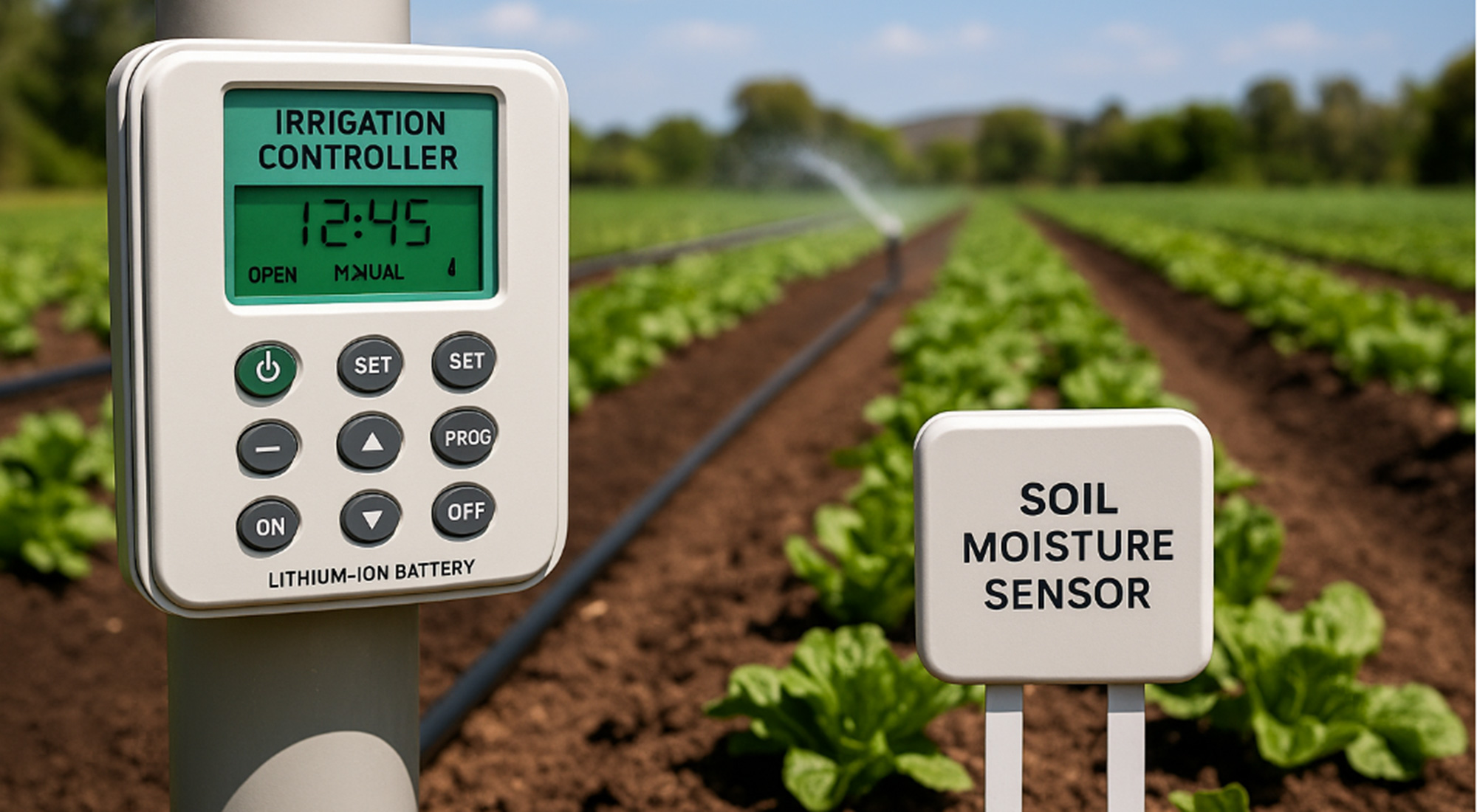
Reliable Power for Soil Sensors: The Role of Custom Lithium Batteries in Precision Agriculture
How PKNERGY custom lithium battery packs enable long-life, stable, and maintenance-friendly power for soil sensors and precision-agriculture IoT deployments.
Industry Background
Soil sensors are foundational tools in today’s precision-agriculture ecosystem. From monitoring moisture and nutrient
levels to analyzing temperature and salinity, these compact IoT devices provide the real-time insights farmers need to
optimize crop health and maximize yield. But because soil sensors often operate in remote fields under challenging
environmental conditions, their performance depends heavily on the quality of their power source.
Precision agriculture has been expanding rapidly as food production faces rising environmental and economic pressure.
Farmers now rely heavily on distributed sensor networks to guide irrigation decisions, fertilizer use, soil health
predictions, and yield forecasting. Soil sensors—often deployed in large numbers—must work continuously and reliably,
sometimes for years without maintenance.
This shift has accelerated demand for battery technologies capable of delivering long life, stable voltage
output, and compatibility with low-power wireless communication protocols. For many projects, working with a
professional custom-battery partner like PKNERGY early in the design process is key to achieving these goals.
Pain Points in Soil Sensor Power Design
Soil sensors face unique operational challenges that strongly influence battery selection and pack design:
- Long deployment cycles:
Devices may need to operate 1–3 years without replacement, especially in large-scale field deployments where
maintenance access is limited. - Low power but high consistency:
Even small fluctuations can affect measurement accuracy, calibration, or wireless transmission stability. - Compact mechanical design:
Sensors are often slender stakes or buried modules that require thin, narrow, or specially shaped batteries. - Environmental stress:
Moisture, soil acidity, temperature changes, UV exposure, and mechanical load can all impact power systems and pack
housing. - Compatibility with IoT networks:
LoRaWAN, NB-IoT, Zigbee, and BLE modules require stable discharge profiles and reliable pulse current.
Traditional alkaline or lead-based solutions fall short on energy density, reliability, and overall lifecycle costs,
especially when long deployment and minimal maintenance are required.
Solution Value: Why Lithium Batteries?
Lithium battery technology brings clear advantages to soil-sensor applications:
- High energy density:
Supports ultra-compact sensor designs while extending operational lifespan and reducing replacement frequency. - Low self-discharge:
Allows devices to stay dormant for long periods while preserving energy, which is ideal for duty-cycled sensing and
transmission. - Stable voltage output:
Critical for wireless transmission modules and microcontrollers to maintain consistent performance. - Superior lifecycle cost:
Long service life significantly reduces maintenance effort and site visits for farmers and system integrators. - Fully customizable:
Designers can specify shape, size, connector, capacity, and voltage to match the sensor housing and energy budget.
For soil sensors, small LiPo pouches and cylindrical cells—such as 14250, 14500, 18650—are common selections depending
on power needs. PKNERGY can provide both
Custom Lithium Polymer Battery packs for slim designs and
LiFePO4 battery customization for long-life and high-safety applications.
Technical Insights for Soil Sensor Batteries
Soil sensors typically operate in the 3.0–12.0 V range, depending on:
- Sensor type (moisture, EC, NPK, temperature, pH)
- Wireless communication method (LoRaWAN, NB-IoT, Zigbee, BLE, etc.)
- Data sampling frequency and reporting interval
- Logging and onboard memory features
PKNERGY custom battery solutions support:
- LiPo cells for slim, embedded designs in narrow probes or compact enclosures.
- Cylindrical Li-ion cells for long runtime and higher capacity modules.
- Rechargeable packs for solar-assisted systems where a small PV panel keeps the battery topped up for
multi-year deployment. - Integrated PCM/BMS protection for over-charge, over-discharge, and over-current.
- Custom wire harnesses, waterproofing treatment, and connector options tailored to your electronics.
PKNERGY also helps customers optimize energy budgets by analyzing duty cycles, sleep modes, and wireless-transmission
peaks. Based on measurement and simulation, we can size the pack correctly and choose the most suitable chemistry.
Battery Options & Application Matching
Different soil sensor designs call for different lithium battery solutions. The table below provides a quick overview:
| Sensor Type | Recommended Battery Type | Typical Voltage | Key Benefits |
|---|---|---|---|
| Basic soil moisture probe | Small LiPo pouch (Custom pack) | 3.0–3.7 V | Very compact, easy to integrate into slim housings, good for low-data-rate IoT |
| Multi-parameter soil sensor (EC, temp, moisture) | Cylindrical Li-ion (14500 / 18650) | 3.7–7.4 V | Higher capacity and longer runtime for more complex sensor suites |
| Solar-assisted field node | Li-ion or LiFePO4 pack with BMS | 3.2–12.8 V | Compatible with solar charging, long cycle life, high safety for remote deployments |
| High-frequency sampling station | High-capacity Li-ion pack | 7.4–11.1 V | Supports frequent sensing and transmission with robust discharge performance |
For emerging projects or future-proof designs, PKNERGY can also evaluate
Custom Sodium-ion Battery
or other advanced solutions when they align with your cost and performance targets.
Typical Use Cases
PKNERGY’s lithium battery solutions are widely used in:
- Soil moisture and salinity meters used in open fields, orchards, and greenhouse environments.
- Smart irrigation decision systems that combine soil data with weather and crop models.
- Wireless NPK (nitrogen-phosphorus-potassium) sensors deployed in dense networks.
- Vineyard soil monitoring nodes for high-value grapes and specialty crops.
- Greenhouse soil-condition networks integrating multiple sensors per node.
- Forest and ecological research stations that require long-term, low-maintenance monitoring.
These applications rely on consistent, long-life performance that custom lithium batteries can reliably provide. By
combining robust chemistry, tailored pack design, and appropriate protection electronics, PKNERGY helps agriculture
technology companies deliver reliable soil-sensor solutions at scale.
If your IoT roadmap also includes other detection or sensing devices, you can reference PKNERGY’s
Portable Detection Device Power Solution
and
Consumer Electronics Power Solution
for additional inspiration.
FAQ: Soil Sensor Battery Design
1. How long can a custom lithium battery power a soil sensor?
It depends on capacity, communication frequency, and duty cycle. With an optimized design, many soil sensors can run
from 1–3 years on a single battery or rechargeable pack, especially when combined with low-power wireless protocols
and efficient sleep modes.
2. Should I choose primary lithium cells or rechargeable lithium packs?
Primary cells are simple and can offer long life in non-rechargeable designs, but they require full replacement when
depleted. Rechargeable packs paired with small solar panels can support true long-term deployments with minimal
maintenance. PKNERGY can evaluate your deployment model and recommend the best approach.
3. How does PKNERGY improve waterproofing and environmental resistance?
We can apply special sealing structures, potting, heat-shrink + glue, or custom housings, along with corrosion-resistant
materials and connectors. The final design is validated through humidity, temperature-cycle, and other reliability tests.
4. Can PKNERGY help with energy budget and system-level optimization?
Yes. Our engineering team can analyze your sensor’s current consumption in each mode (sleep, sampling, transmission),
then simulate lifetime under different pack options. This allows you to choose a cost-effective solution while
meeting deployment targets.
Contact Cassie — PKNERGY
Planning a new soil sensor or precision-agriculture IoT project? Share your sensor type, housing size,
target lifetime, communication protocol, and expected deployment scale, and Cassie will help you define a practical
custom lithium battery solution.
- Contact: Cassie (Product Expert)
- Email: sale4@pknergy.com
- Phone / WhatsApp: +86 13974604556
Or submit your project details directly via our online form:
Contact Us — Get a Quote.