
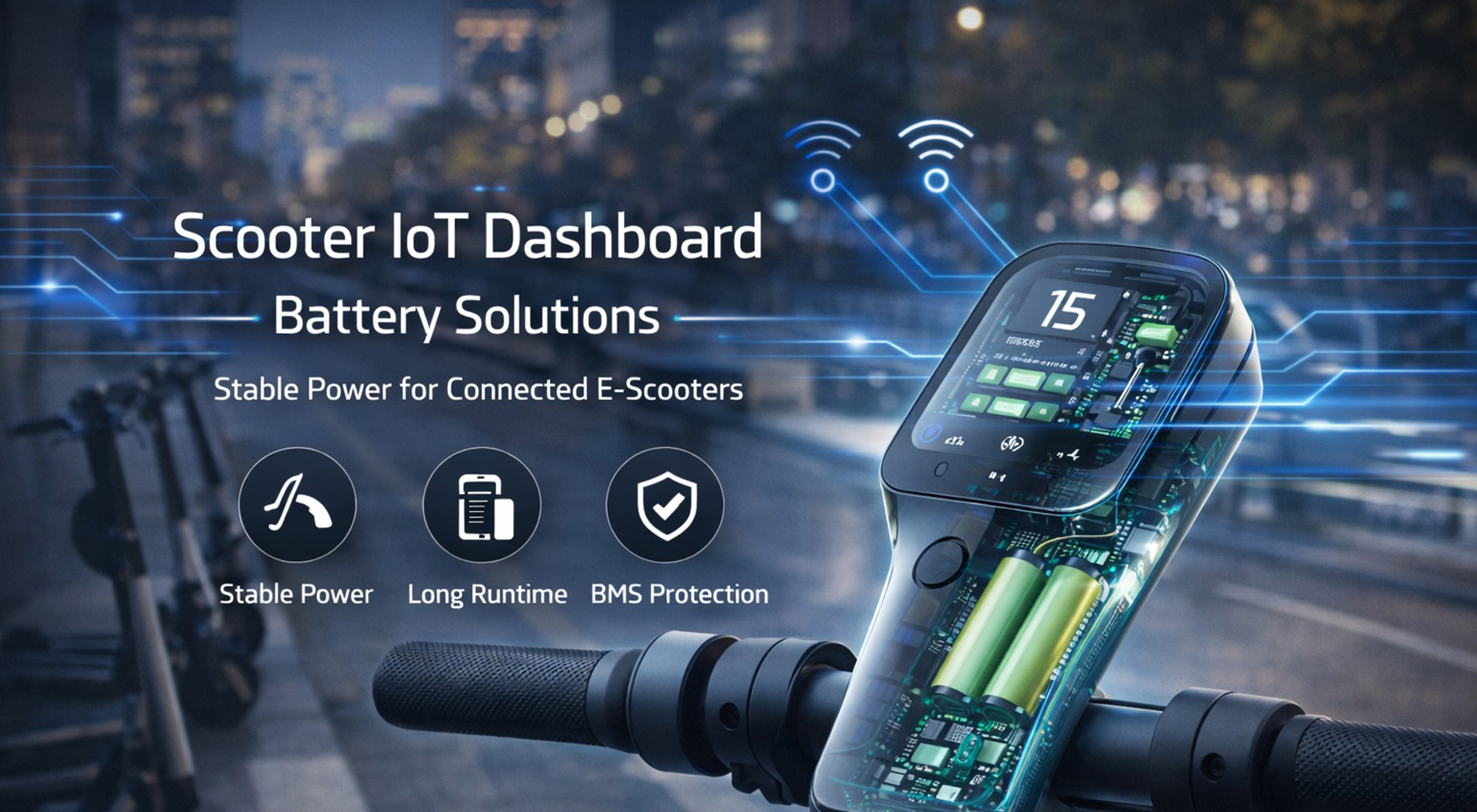
Scooter IoT Dashboard Battery Solutions
Why Stability, Connectivity, and Accuracy All Depend on the Battery
E-Scooter · IoT Dashboard · Lithium Battery
1. The Dashboard Is Now the IoT Core of the Scooter
With the rapid growth of shared mobility and electric scooters, the IoT dashboard has evolved from a simple speedometer into the central control and communication hub of the vehicle.
Modern scooter dashboards integrate MCU control, BLE connectivity, NB-IoT / LTE-M / 4G modules, OTA firmware updates, GPS positioning, anti-theft systems, and real-time diagnostics.
To support these functions reliably, the battery must deliver stable voltage during communication bursts, tolerate harsh outdoor environments, and maintain long standby operation.
2. Why Scooter Dashboards Fail in Real-World Use
2.1 High Peak Current from Communication Modules
IoT dashboards experience sudden current spikes during network attachment, data upload, GPS refresh, and OTA updates. Weak batteries cause reboots, frozen screens, or failed updates.
2.2 Outdoor Heat Accelerates Battery Aging
Under direct sunlight, dashboard temperatures can reach 65–75°C. Poor-quality batteries suffer rapid capacity loss, swelling, and voltage instability.
2.3 Fake Capacity Leads to Early Shutdown
Many low-cost solutions use recycled cells or exaggerated capacity ratings, resulting in shortened standby time and frequent offline scooters.
2.4 Extremely Limited Internal Space
Dashboards must fit display modules, PCBs, waterproof sealing, and wiring, leaving very limited room for batteries.
3. Battery Solutions for Scooter Dashboards
Solution A — 18650 Lithium Battery
3.7V · 2000–3500mAh
Best for standard IoT dashboards with moderate communication load.
Solution B — 21700 Lithium Battery
3.7V · 4000–5000mAh
Designed for high-performance scooters and long standby requirements.
Solution C — Custom Li-Po Polymer Battery
Ideal for ultra-thin dashboard housings and complex mechanical constraints, offering flexible shape and lightweight design.
4. Engineering Factors That Matter
- BMS protection: overcharge, over-discharge, overcurrent, short circuit
- NTC temperature monitoring
- Low internal resistance for communication bursts
- Vibration-resistant structure
- 500–1000 cycle life
- Optional fast charging (1C–1.5C)
:contentReference[oaicite:2]{index=2} provides full battery pack development including cell selection, BMS design, wiring, and mechanical integration.
5. Application Scenarios
- Shared electric scooters
- Private e-scooters
- GPS-enabled dashboards
- Anti-theft control units
- Fleet management systems
6. Conclusion — Dashboard Stability Depends on Battery Stability
Many dashboard failures appear as software or communication issues, but the root cause is often unstable battery power.
Reliable IoT dashboards require stable voltage output, true capacity cells, high-temperature endurance, and long cycle life.
Contact Miah — PKNERGY
If you are developing or upgrading an electric scooter IoT dashboard, feel free to discuss your battery requirements directly.
- Name: Miah
- Email: sale@pknergy.com
- WhatsApp: +86 139 0246 3897