
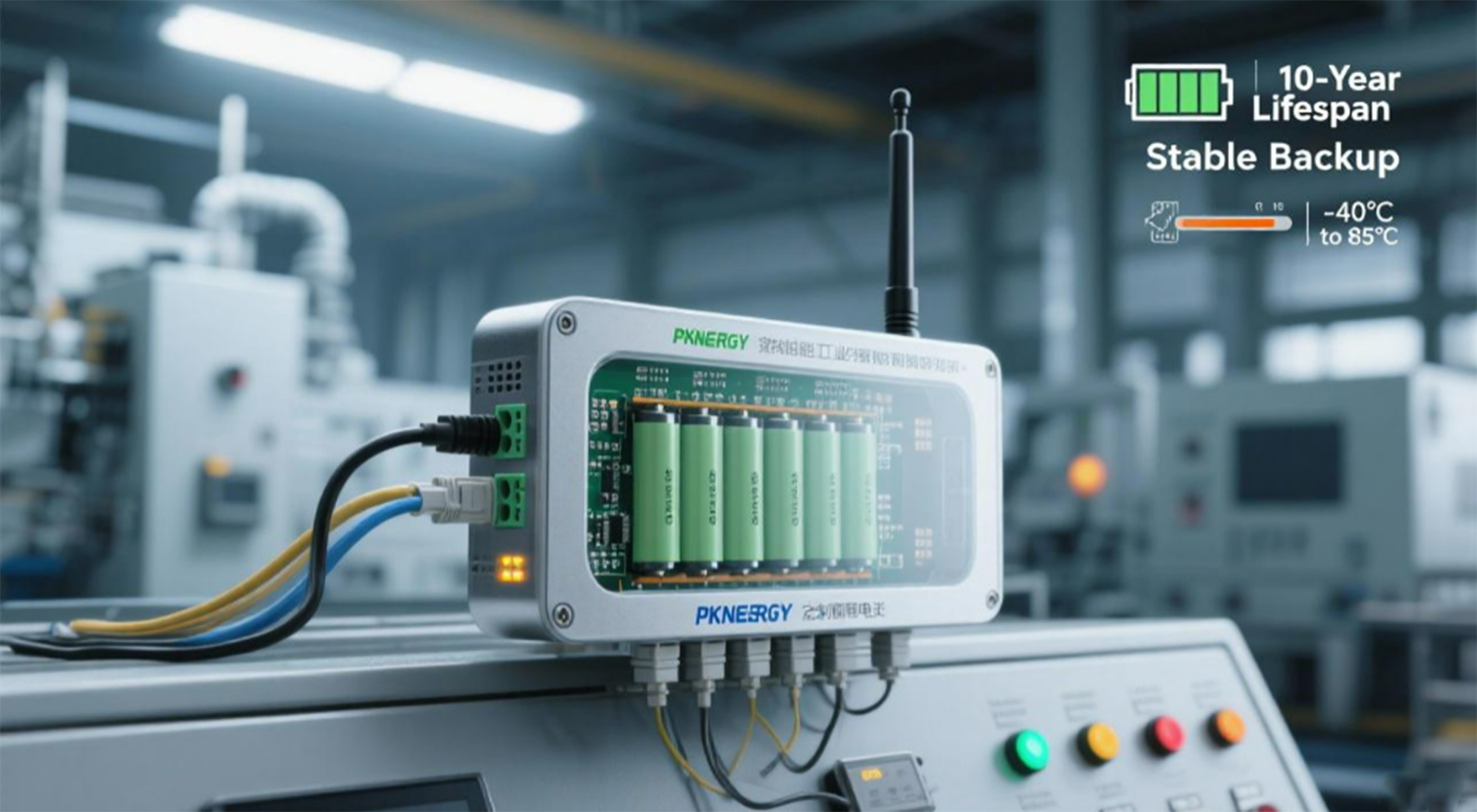
Why 18650 Lithium Batteries Are Becoming the Preferred Power Source for IoT Gateways
As IoT deployments expand into remote, industrial, and outdoor environments, 18650 lithium batteries are becoming
the new standard for powering reliable IoT gateways.

01 | Why do IoT gateways need battery power?
As IoT deployments continue expanding into remote, industrial, and outdoor environments, IoT gateways have
become the backbone of modern connected systems. They aggregate data, manage communications, and act as local
“mini hubs” for thousands—sometimes millions—of IoT nodes. But behind every stable IoT gateway lies one decisive
factor: a reliable power source. :contentReference[oaicite:0]{index=0}
Unlike ultra-low-power IoT sensors, gateways require significant energy to support multi-protocol connectivity,
edge computing, and real-time data transmission. This is why an increasing number of engineers and product teams
are choosing cylindrical 18650 lithium-ion batteries as the optimal balance of safety, cost, and long-term
performance.
Many gateways operate in locations where stable AC power is not guaranteed—or not available at all:
- Outdoor smart-city poles
- Subway tunnels and underground pipes
- Farmland and forest monitoring stations
- Distributed industrial control cabinets
- Temporary or mobile deployment sites
In these scenarios, a battery must support:
- Continuous operation under 0.5 W–10 W loads
- UPS-style backup when AC fails
- High pulse current during network transmission (1–2 A)
- Reliable performance in harsh environmental conditions
For applications that require higher safety margin, long calendar life, or wide temperature performance,
PKNERGY can also design custom LiFePO4 battery
packs or custom lithium polymer battery
packs based on the same gateway platform.
02 | Why 18650 batteries outperform other options
For many IoT gateways, 18650 cells hit the sweet spot between power capability, energy density, and mechanical
robustness.
1. Outstanding pulse-current capability
Communication modules generate rapid current spikes. Low-quality or high-resistance batteries may cause voltage
drops, device resets, or packet loss. High-grade INR 18650 cells maintain a stable voltage plateau even under
heavy burst loads, ensuring stable connectivity for multi-protocol gateways (LoRaWAN, NB-IoT, 4G/5G, Wi-Fi, etc.).
2. Higher energy density for longer uptime
Typical 18650 capacities range from 2600 mAh to 3500 mAh. Common pack configurations for IoT gateways include:
- 1S1P (3.7 V) — compact single-cell pack
- 1S2P (3.7 V, large capacity)
- 2S1P (7.4 V) — for higher system voltage
- 2S2P (7.4 V, high capacity)
- 3S1P (11.1 V) — for more demanding gateway platforms
PKNERGY designs custom lithium battery packs based on the gateway’s input voltage, standby time, and enclosure
constraints, so engineers can achieve the best balance between runtime and size.
3. Industrial-grade durability
18650 cells offer strong mechanical stability, improved safety, and lower swelling risk compared to many soft
LiPo packs—an important advantage in harsh industrial and outdoor conditions where vibration, temperature
swings, and long installation cycles are common.
03 | Typical IoT gateway applications using 18650 batteries
18650 lithium battery packs are already widely used in different IoT gateway scenarios, such as:
- LoRaWAN outdoor micro-base stations
- NB-IoT agricultural and environmental monitoring gateways
- Smart-city field gateways
- Edge computing video gateways
- Industrial PLC/SCADA remote gateways
Depending on the application, PKNERGY can combine solar charging, DC input, or UPS backup modes so that gateways
continue working even during power outages or maintenance windows.
For mobile and robotics scenarios such as AMR/AGV platforms, you can also reference our
Mobile Robot Power Solution and
AGV battery solution, which share similar pack
design principles and protection strategies.
04 | How PKNERGY customizes power solutions for IoT gateways
Every IoT gateway platform has its own power input range, firmware behavior, startup current profile, and
mechanical constraints. PKNERGY provides end-to-end customization to ensure the battery pack fits both
electrically and mechanically.
A. Pulse-current optimization for stable communication
We select appropriate INR 18650 cells, design the pack layout, and size the protection/PCM/BMS components to
handle high pulse currents during RF transmission, modem registration, or edge AI processing, minimizing the
risk of brownouts and restarts.
B. Enhanced low-temperature performance
For gateways deployed in cold regions or high-altitude locations, PKNERGY can match cell chemistry and
electrolyte formulation that maintain usable capacity at low temperatures, and optimize charging windows to
protect the pack.
C. Full customization options
Our engineering team supports a wide range of design parameters, including:
- Pack configurations: 1S / 2S / 3S, single or multi-parallel
- Connectors and wire gauge matched to your PCB and current profile
- PCM/BMS with protections (OVP, UVP, OCP, SCP, NTC sensing)
- Mounting brackets, insulation, and mechanical design to fit your housing
If your roadmap includes future migration to sodium-ion or other chemistries, we can also pre-study
custom sodium-ion battery solutions for the
same gateway platform.
D. Consistency and long-term reliability
To support long deployment cycles, PKNERGY implements IR matching, capacity grading, and environmental stress
tests on battery packs. This reduces field failure rates and ensures that distributed gateways maintain stable
runtime over years of operation.
05 | Conclusion: The 18650 battery is becoming the new standard for IoT gateways
A high-quality 18650 battery pack ensures reliable communication, longer deployment cycles, reduced maintenance
cost, and stronger environmental resilience for IoT gateways.
For next-generation IoT gateway development, the right battery partner is as important as the right chipset. By
working with a specialized custom battery manufacturer like PKNERGY, you can optimize pack performance, safety,
and cost from the early design stage.
Discuss your IoT gateway power requirements with our team and we will help you choose the right 18650 pack
configuration, protection strategy, and long-term supply plan.
For more information about our capabilities and project experience, you can also explore:
FAQ,
Consumer Electronics Power Solution,
and Security Devices Power Solution.
Discuss with Miah — Product Expert at PKNERGY
Email: sale@pknergy.com
WhatsApp: +86 139 0246 3897
18650 vs Other Battery Options for IoT Gateways
| Battery Type | Typical Use in IoT Gateways | Key Advantages | Potential Limitations |
|---|---|---|---|
| INR 18650 Li-ion | Most industrial and outdoor IoT gateways | High pulse current, good energy density, robust cylindrical design | Requires proper BMS and mechanical design |
| LiFePO4 (Cylindrical/Prismatic) | Long-life, high-safety gateways, backup systems | Excellent cycle life, high safety, good thermal stability | Lower energy density vs. high-Ni Li-ion |
| LiPo (Pouch Cell) | Very compact enclosures, special form factor devices | Flexible size and shape, lightweight | Higher swelling risk, more sensitive to mechanical stress |
| Sodium-ion (Emerging) | Pilot projects, cost-sensitive, moderate-energy systems | Potentially lower cost, better low-temperature performance (by chemistry) | Still emerging, limited standardization and supply chain |
Need help choosing between these chemistries for your gateway roadmap?
Our engineering team can compare options based on your device duty cycle, environment, and TCO.
FAQ: 18650 Battery Packs for IoT Gateways
Q1: How do I choose the right 18650 pack configuration for my IoT gateway?
Start from your gateway input voltage, peak and average power, and required backup time. For example,
many compact gateways work well with 1S or 2S packs, while higher-power edge computing gateways may need
3S packs. PKNERGY will calculate pack capacity (Ah), discharge current, and BMS parameters based on your
firmware behavior and real duty cycle.
Q2: Can 18650 battery packs support solar-powered IoT gateways?
Yes. 18650 packs are widely used in solar-powered gateways. We design the charge controller and pack
parameters to match solar panel size, local irradiation, and required autonomy days. For outdoor systems,
we also consider temperature range and waterproofing of the enclosure.
Q3: What if my gateway needs ultra-long cycle life or wide temperature range?
In that case, PKNERGY may recommend LiFePO4 or wide-temperature stacked cell solutions instead of standard
INR 18650. We can also study hybrid approaches and help you choose between
LiFePO4 battery customization and
cylindrical Li-ion, depending on your field conditions and budget.
Q4: How does PKNERGY ensure consistency across thousands of deployed gateways?
We perform IR and capacity grading for cells, tightly control production process, and run environmental
stress tests for sample packs. This reduces variation between packs so that thousands of gateways in the
field behave consistently in terms of runtime and aging.
Q5: How can I start a custom IoT gateway battery project with PKNERGY?
Simply share your gateway datasheet, power profile, expected installation environment, and target cost. We
will recommend a pack configuration (1S/2S/3S), cell type, and BMS solution, then build prototypes for
validation. You can reach us via the contact form on
Contact Us or by emailing Miah directly below.
Contact Miah — PKNERGY
Ready to design a reliable 18650 battery pack for your IoT gateway project?
Miah and the PKNERGY engineering team can help you optimize voltage, capacity, and pack structure to fit your
device and application.
- Contact: Miah (Cui Juan)
- Email: sale@pknergy.com
- WhatsApp: +86 139 0246 3897
- Website: https://pknergybattery.com
You can also follow PKNERGY on:
YouTube,
LinkedIn,
X,
Facebook,
TikTok.
Or submit your project details via our online form:
Get a Quote.