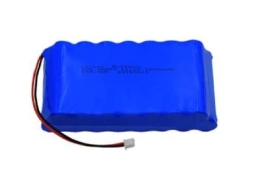
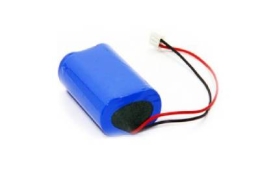
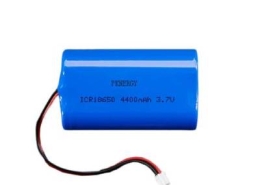
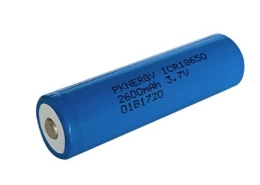



Lithium-ion Battery Pack
80Ah typical capacity and approximately 280Wh nominal energy provide extended operating time while reducing the number of parallel cells required in large battery modules.
Supports up to 3C continuous discharge, equivalent to approximately 240A under specified test conditions, making it suitable for applications with sustained power demand.
Delivers up to 10C pulse discharge for 10 seconds when SOC is above 50%, equivalent to approximately 800A, supporting motor startup, actuator operation and other temporary peak loads.
Supports charging from 0°C to 55°C and discharging from -40°C to 55°C. At -40°C and 0.2C discharge, the cell is specified to deliver at least 60% of nominal capacity.
An initial AC impedance of no more than 0.7mΩ and DC internal resistance of no more than 3.0mΩ help reduce voltage drop and heat generation under high-current loads.
The cell can be integrated into customized series and parallel battery configurations according to required voltage, capacity, power, communication and installation requirements.
| No. | Item | Characteristics | Remarks |
|---|---|---|---|
| 1 | Cell Type | Rechargeable lithium-ion pouch cell | Large-format cell |
| 2 | Model | LP107110300 | — |
| 3 | Material System | NCM | Nickel-cobalt-manganese chemistry |
| 4 | Nominal Capacity | 80Ah typical | At 0.2C discharge |
| 5 | Nominal Voltage | 3.5V | Platform voltage at 0.2C |
| 6 | Nominal Energy | Approx. 280Wh | Calculated from 3.5V × 80Ah |
| 7 | Shipment OCV | 3.60–3.95V | Open-circuit voltage |
| 8 | Charge Cut-off Voltage | 4.30V | CC/CV charging |
| 9 | Discharge Cut-off Voltage | 2.50V at T ≥ 0°C; 2.20V at T < 0°C | System protection should follow temperature conditions |
| 10 | Standard Charge | 0.2C CC to 4.30V, then CV to 0.05C | Approx. 16A charge; 4A termination current |
| 11 | Rapid Charge | 1C to approximately 80% SOC | Applicable at 20°C–35°C |
| 12 | Standard Discharge | 0.2C to 2.50V | Approx. 16A at 25 ±2°C |
| 13 | Maximum Continuous Discharge | 3C | Approx. 240A under specified conditions |
| 14 | Pulse Discharge Current | 10C for 10 seconds | Approx. 800A; SOC above 50% |
| 15 | AC Initial Impedance | ≤0.7mΩ | Measured at AC 1kHz |
| 16 | DC Internal Resistance | ≤3.0mΩ | 50% SOC, 1C for 10s, 25 ±3°C |
| 17 | Charging Temperature | 0°C to 55°C | High and low temperatures may reduce charging efficiency |
| 18 | Discharging Temperature | -40°C to 55°C | — |
| 19 | Recommended SOC Range | 5%–95% | For normal system use |
| 20 | Cell Weight | Approx. 706 ±35g | — |
| 21 | Maximum Cell Size | 10.7 × 111 × 302mm | Thickness at 100% SOC |
| 22 | Recommended Shipment SOC | Approximately 50% SOC | — |
Electrochemical performance characteristics
| Test Item | Requirement | Test Condition |
|---|---|---|
| Capacity at 0.2C | ≥100% of nominal capacity | Discharge to 2.5V at 25 ±5°C after standard charge |
| Capacity at 1C | ≥95% of nominal capacity | Discharge to 2.5V at 25 ±5°C after standard charge |
| Capacity at 3C | ≥80% of nominal capacity | Discharge to 2.5V after standard charge |
| Capacity at -20°C | ≥80% of nominal capacity | 0.2C discharge to 2.0V after standing at -20 ±2°C for 4 hours |
| Capacity at -40°C | ≥60% of nominal capacity | 0.2C discharge to 2.0V after standing at -40 ±2°C for 4 hours |
| Capacity at 55°C | ≥95% of nominal capacity | 0.2C discharge to 2.5V after standing at 55 ±2°C for 5 hours |
| 25°C Storage Retention | ≥95% | After 28 days of storage |
| 25°C Capacity Recovery | ≥97% | After recharge following the retention test |
| 45°C Storage Retention | ≥90% | After 28 days of storage |
| 45°C Capacity Recovery | ≥95% | After recharge following the retention test |
| 55°C Storage Retention | ≥90% | After 7 days of storage |
| 55°C Capacity Recovery | ≥95% | After recharge following the retention test |
Warranty
The warranty period for this product is 1 year from the date the product left the manufacturer’s door.
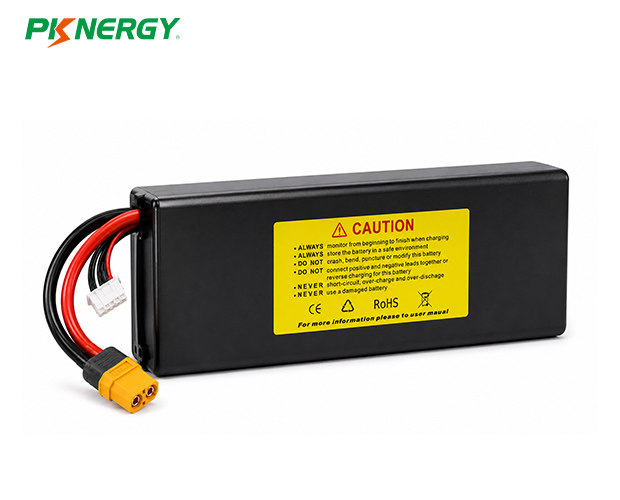
Battery Packing Label
The following warnings should be indicated on the battery pack labels.







Lorem ipsum dolor sit amet
1.Is the LP107110300 a finished battery pack?
No. The LP107110300 is a bare rechargeable lithium-ion pouch cell. It must be integrated into a professionally designed battery module with a suitable BMS, electrical protection, insulation, mechanical support and thermal management.
2. What is the nominal energy of this cell?
The nominal energy is approximately 280Wh, calculated from its 3.5V nominal voltage and 80Ah nominal capacity.
3.What is the maximum continuous discharge current?
The cell supports a maximum continuous discharge rate of 3C under the specified test conditions, equivalent to approximately 240A.
4. Can the cell operate at -40°C?
The specified discharge operating range extends to -40°C. Under the specified -40°C test condition and 0.2C discharge, capacity is required to be at least 60% of nominal capacity.

 PKNERGY C8574170HP 3.5V 23Ah High-Power Lithium Polymer Pouch Cell