SMART BMS &
COMMUNICATION

Intelligent Battery Management for UAV Applications

Discover how smart battery management supports battery protection, real-time data monitoring and communication with compatible flight controllers and onboard systems.

✓ BATTERY PROTECTION
✓ DATA MONITORING
✓ SYSTEM INTEGRATION

01 / BMS FUNDAMENTALS

What Is a BMS for UAV Batteries?

A Battery Management System (BMS) monitors and manages battery-pack operation. Depending on its architecture, it can support electrical protection, battery-state estimation, cell balancing and communication with external equipment. The exact functions depend on the selected design.

♢

Protection

Voltage, current and temperature limits

▥

Measurement

Voltage, current, temperature and SOC where supported

⚖

Cell Balancing

Cell voltage management where equipped

⌁

Communication

Battery data exchange via supported interfaces

PKNERGYBATTERY BMS circuit board with electronic components and connectors
02 / BMS FUNCTIONS

Smart BMS Key Functions

01

Battery State Estimation

Smart designs may estimate state of charge (SOC) and state of health (SOH) using available measurements and calculation algorithms.

02

Protection and Fault Alerts

Depending on the design, the BMS monitors operating limits and records or reports supported fault conditions.

03

Cell Balancing

Multi-cell packs may use passive or active balancing to manage differences between cell voltages when balancing circuitry is included.

04

Advanced Functions

Data logging, configurable parameters, firmware updates and other features depend on the selected BMS hardware and software.

Communication BMS Overview

A communication-enabled BMS exchanges supported battery information with compatible external systems. Successful integration requires agreement on the physical interface, message format, data units and system behavior.

⚙

Multi-Protocol Support

CAN, UART and other supported interfaces

▤

Real-Time Data

Voltage, current, temperature and status where available

↔

Command Response

Supported configuration and control functions

⌘

System Integration

Compatibility with the host system

03 / COMMUNICATION PROTOCOLS

Common BMS Communication Protocols

Different interfaces serve different purposes. Select based on device compatibility, wiring, communication requirements and the protocol supported by the host system.

Interface Key Features Typical Applications Integration Considerations
CAN / CAN FD Robust bus communication, arbitration and error detection. Compatible flight controllers and control systems. Confirm bus topology, termination, transceivers and message definitions.
UART Simple point-to-point serial communication. Configuration, debugging and supported serial data links. Confirm TX/RX, logic voltage, baud rate and message format.
I²C / SPI Short-distance communication between electronic components. Board-level connections between chips and controllers. Check signal timing, wiring and electrical compatibility.
RS485 / RS232 Serial communication options for compatible equipment. Industrial monitoring, configuration or supported control systems. Confirm electrical levels, network design and higher-level protocol.
SMBus System-management communication for compatible smart batteries. Host systems designed to support the relevant smart-battery interface. Confirm command set, version and host implementation.

Note: CAN, UART, I²C, SPI, RS485 and RS232 describe interfaces or communication mechanisms. The data protocol must also be compatible between the BMS and the connected device.

04 / SYSTEM INTEGRATION

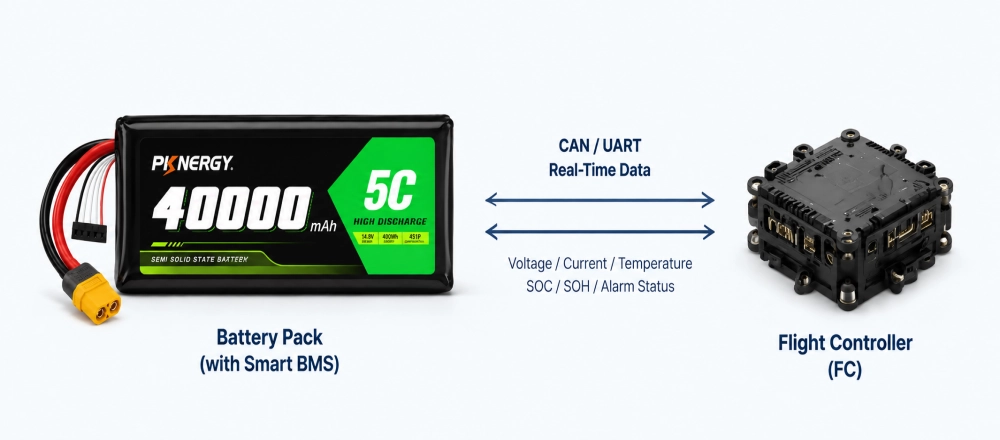
BMS Integration with UAV Flight Controller

The BMS and flight controller must share a compatible interface and message protocol. Integration testing should verify the data received and the system’s response to warnings and communication faults.

PKNERGYBATTERY UAV battery BMS connected to a flight controller through a supported communication interface

Key Integration Requirements

  • Confirm the communication interface and electrical compatibility.
  • Follow the flight controller’s supported battery protocol.
  • Map available voltage, current, temperature, SOC and alarm fields.
  • Define the host response to low-battery alerts and invalid data.
  • Validate wiring, connector retention and communication stability.

Technical note: BMS features, communication compatibility, protection thresholds and performance vary by product design. Verify product-specific functions and system compatibility against the relevant documentation and validation results.


    LET’S DISCUSS YOUR PROJECT

    Discuss Your UAV Battery Solution

    Tell us about your UAV application, BMS requirements, and communication needs. Our engineering team will help you identify the right battery management and integration solution.