
PKNERGY | Advanced UAV Battery Technology
Semi-Solid-State UAV Batteries for Long-Endurance Drone Platforms
In professional UAV applications, battery performance directly influences flight endurance, payload capacity, mission efficiency, and overall aircraft capability. PKNERGY develops high-energy-density semi-solid-state UAV batteries for drone manufacturers, UAV OEMs, and specialized aerial projects seeking advanced power solutions.
With energy density specifications of up to 450Wh/kg, capacities from 36Ah to 60Ah, and multiple voltage configurations, our semi-solid-state battery series supports long-endurance multirotors, agricultural drones, mapping platforms, industrial inspection UAVs, cargo drones, and VTOL aircraft. Custom battery design is also available to match specific flight profiles and aircraft integration requirements.
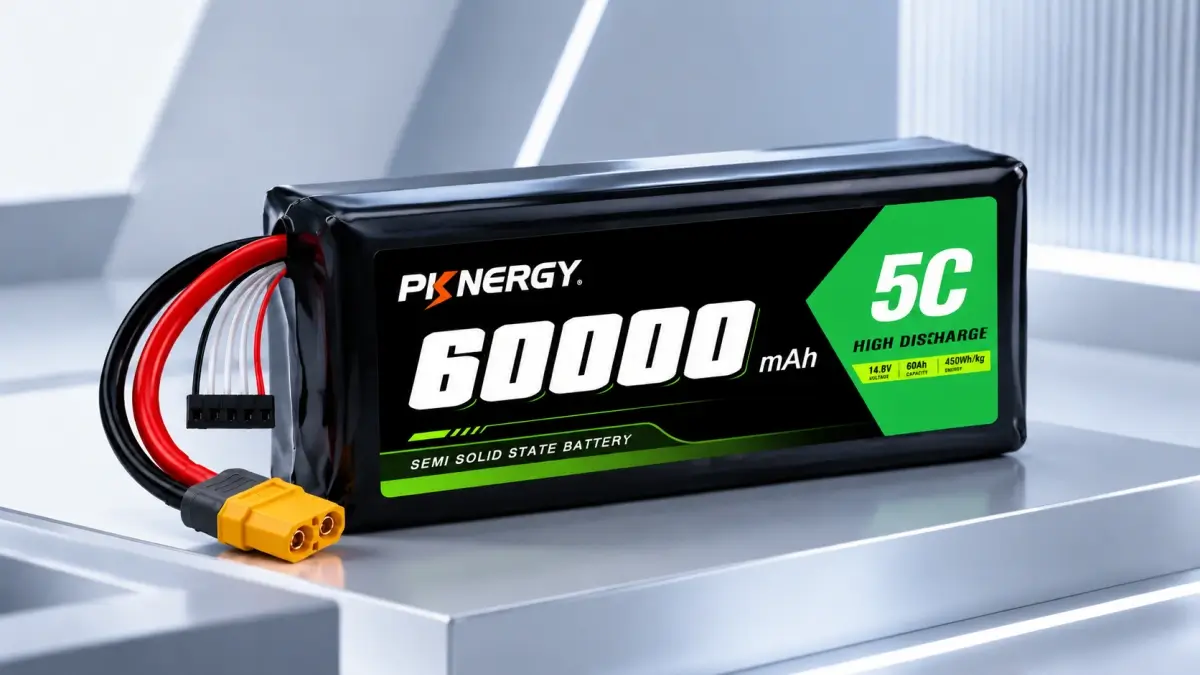
PKNERGY High Energy Density Semi-Solid-State UAV Battery
1. High Energy Density for Extended Flight Endurance
Semi-solid-state battery technology uses a semi-solid electrolyte approach to battery design. Combined with high-specific-energy cell chemistry, it provides a development pathway for UAV power systems where energy density, weight, and available installation space are critical.
PKNERGY’s semi-solid-state UAV battery series offers cell energy density specifications of up to 450Wh/kg. Higher specific energy can help aircraft designers optimize the balance between battery weight, onboard payload, and mission duration. Actual flight endurance depends on aircraft weight, propulsion efficiency, flight conditions, and mission profile.
ENERGY DENSITY
450Wh/kg
Up to the specified cell-level energy density
CAPACITY OPTIONS
36–60Ah
Multiple capacity configurations
VOLTAGE OPTIONS
4S–14S
For different UAV power architectures
2. Designed Around UAV Flight Performance
Selecting a UAV battery requires more than matching voltage and capacity. Battery discharge capability, power-to-weight ratio, peak current, and aircraft power consumption all influence flight performance.
Flight Endurance
Higher specific energy can help increase available onboard energy and support longer mission duration.
Discharge Performance
Continuous discharge ratings of 2C support defined propulsion and onboard power requirements.
Payload Optimization
Battery weight and dimensions can be evaluated alongside payload capacity and aircraft structural limits.
Power Integration
Voltage, current, connectors, BMS, and power interfaces can be considered during UAV integration.
3. UAV Applications & Compatible Drone Platforms
PKNERGY semi-solid-state UAV batteries are developed for professional drone applications where flight endurance, payload requirements, and battery integration are key design considerations.
Mapping & Surveying UAVs
For aerial surveying, photogrammetry, LiDAR mapping, and geospatial data collection. Battery capacity and weight can be optimized for extended flight missions and sensor payload integration.
Agricultural & Spraying Drones
For crop spraying, precision agriculture, and field operations. Battery selection should account for takeoff weight, liquid payload, motor demand, discharge current, and repeated flight cycles.
Industrial Inspection UAVs
For power line inspection, infrastructure monitoring, energy facilities, and industrial asset inspection. Long-endurance battery configurations help support mission planning and onboard equipment operation.
Cargo UAVs & Heavy-Lift Multirotors
For logistics drones and heavy-payload multirotor platforms. Higher-capacity battery options can be evaluated against thrust requirements, takeoff weight, payload, and peak power demand.
VTOL & Long-Endurance UAVs
For vertical takeoff and landing aircraft and other long-endurance UAV platforms. Battery design should consider transition flight, propulsion load, cruise power, and aircraft energy management.
Semi-solid-state battery solutions for professional UAV platforms
4. Semi-Solid-State UAV Battery Specifications
PKNERGY offers 36Ah, 40Ah, and 60Ah semi-solid-state UAV battery options across multiple series configurations. The following reference models cover different aircraft voltage platforms and payload requirements.
| Cell Model | Voltage | Capacity | Configuration | Continuous Current | Peak Current | Weight | Cycle Life |
|---|---|---|---|---|---|---|---|
| 10975175GSH2 | 14.8V | 36Ah | 4S1P | 72A | 180A | 1.15kg | ≥200 |
| 10975175GSH2 | 22.2V | 36Ah | 6S1P | 72A | 180A | 1.90kg | ≥200 |
| 10975175GSH2 | 29.6V | 36Ah | 8S1P | 72A | 180A | 2.50kg | ≥200 |
| 10975175GSH2 | 44.4V | 36Ah | 12S1P | 72A | 180A | 3.80kg | ≥200 |
| 9587191GSH2 | 14.8V | 40Ah | 4S1P | 80A | 200A | 1.40kg | ≥150 |
| 9587191GSH2 | 22.2V | 40Ah | 6S1P | 80A | 200A | 2.10kg | ≥150 |
| 9587191GSH2 | 29.6V | 40Ah | 8S1P | 80A | 200A | 2.80kg | ≥150 |
| 9587191GSH2 | 44.4V | 40Ah | 12S1P | 80A | 200A | 4.25kg | ≥150 |
| 9587191GSH2 | 51.8V | 40Ah | 14S1P | 80A | 200A | 5.00kg | ≥150 |
| 93121220GSH | 14.8V | 60Ah | 4S1P | 120A | 300A | 3.30kg | ≥100 |
| 93121220GSH | 22.2V | 60Ah | 6S1P | 120A | 300A | 3.30kg | ≥100 |
| 93121220GSH | 29.6V | 60Ah | 8S1P | 120A | 300A | 3.30kg | ≥100 |
| 93121220GSH | 48.1V | 60Ah | 13S1P | 120A | 300A | 3.30kg | ≥100 |
Reference specifications based on supplied product data. Peak discharge current is rated for up to 15 seconds. Cycle life and performance depend on test conditions and actual operating profiles. Confirm final specifications before integration.
5. Custom UAV Battery Design & OEM Integration
Every UAV project has different electrical, mechanical, and flight-performance requirements. PKNERGY supports custom semi-solid-state battery development for drone manufacturers, UAV OEMs, system integrators, and project developers.
Customization can cover:
- Voltage platform and series configuration (4S, 6S, 8S, 12S, 14S, and project-specific designs).
- Battery capacity, energy requirements, and discharge current.
- Battery dimensions, enclosure structure, and aircraft mounting interface.
- Power connectors, wiring harness, and output interface.
- BMS functions, voltage and temperature monitoring, and communication requirements.
- Integration considerations for ESC, flight controller, charger, and onboard power systems.
From prototype development and engineering validation to customized battery packs for production programs, PKNERGY works with customers to align battery design with aircraft specifications and mission requirements.
6. How to Select a Battery for Your UAV Project
A suitable UAV battery must match the aircraft’s propulsion system and intended mission. During battery selection, engineering teams should evaluate:
Aircraft Voltage & Propulsion
Confirm the battery voltage range and compatibility with motors, ESCs, and power distribution systems.
Flight Time & Energy Consumption
Estimate mission energy demand, reserve capacity, hover time, and cruise power consumption.
Payload & Takeoff Weight
Evaluate battery mass against payload capacity, maximum takeoff weight, and aircraft balance.
Discharge Rate & Peak Power
Check continuous C-rate, peak discharge current, acceleration demand, and motor load.
Battery Integration & Safety
Verify BMS protection, connectors, mounting, temperature limits, and charging compatibility.
7. Why Choose PKNERGY for UAV Battery Projects?
PKNERGY focuses on application-oriented lithium battery development, providing UAV customers with battery options that address energy density, electrical performance, and aircraft integration.
High-Energy Battery Options
Multiple high-specific-energy battery models for endurance-focused UAV platforms.
Multiple Voltage Platforms
Battery configurations for different aircraft electrical architectures.
Custom Engineering
Project-oriented battery design for OEMs and specialized UAV applications.
8. Frequently Asked Questions
What is a semi-solid-state UAV battery?
It is a lithium battery developed using a semi-solid electrolyte approach. In UAV applications, high-specific-energy designs can help address aircraft weight and endurance requirements.
Can PKNERGY customize batteries for different drone platforms?
Yes. Battery voltage, capacity, dimensions, connectors, wiring, and BMS requirements can be evaluated according to the aircraft design and project specifications.
Can a higher energy density increase UAV flight time?
Higher specific energy can increase available battery energy at a given battery mass. Actual flight time also depends on propulsion efficiency, payload, aircraft weight, weather, and mission profile.
What information is needed for a custom UAV battery quotation?
Useful information includes target voltage, capacity, continuous and peak current, battery dimensions, weight limits, connector type, aircraft model, and intended flight mission.
PKNERGY UAV Battery Solutions
Building Your Next UAV Platform?
Whether you are developing a mapping drone, agricultural UAV, industrial inspection platform, cargo drone, or VTOL aircraft, PKNERGY can help evaluate a suitable semi-solid-state battery solution for your project.