
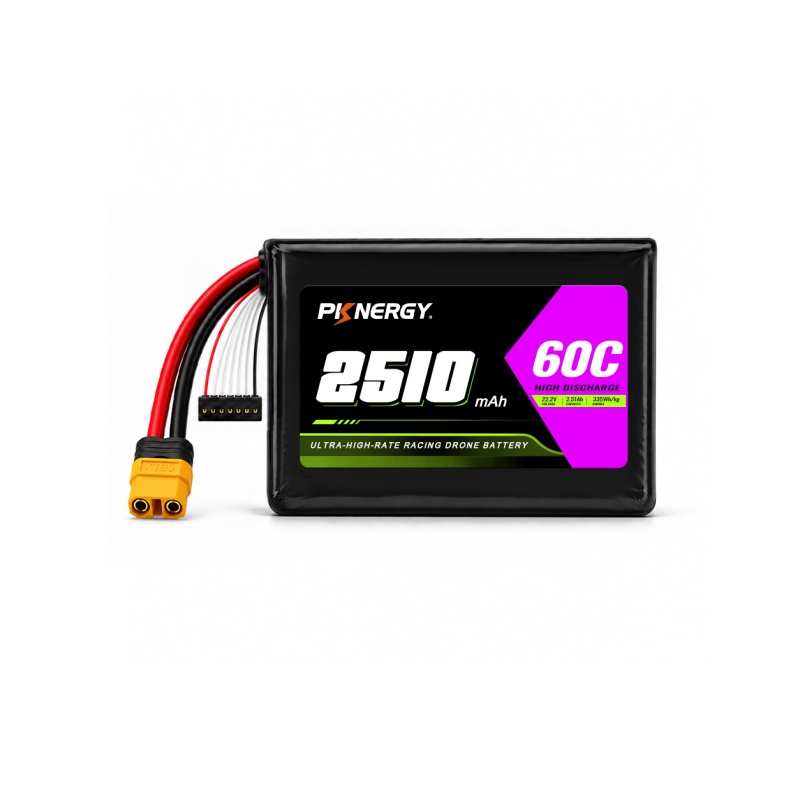
Ultra-High-Rate Racing Drone Battery
606080 60C 22.2V 2510mAh
Ultra-High-Rate Racing Drone Battery for Extreme Power Output
2,510mAh Lightweight Racing Power
The battery provides a nominal capacity of 2,510mAh, delivering a lightweight high-power solution for racing drones requiring fast response and strong current output.
60C Ultra-High-Rate Discharge Capability
Supports 150.6A continuous discharge and 180A peak discharge (≤0.1s), providing rapid power delivery for acceleration, aggressive maneuvers, and competitive FPV racing applications.
335Wh/kg Energy Density
Featuring an energy density of 335Wh/kg, the battery achieves an excellent balance between lightweight design and high-power performance.
High-Voltage Compact Racing Design
With a nominal voltage of 22.2V, a weight of approximately 182g, and dimensions of 84 × 61 × 37mm, the battery is designed for high-voltage racing drones requiring compact size and rapid power response.
Reliable Operating Performance
Supports 0°C to 45°C charging and -20°C to 55°C discharging, with a cycle life of ≥100 cycles for repeated high-performance operation.
SPECIFICATION
| No. | Item | Specification | Remarks |
|---|---|---|---|
| 1 | Battery Type | Ultra-High-Rate Racing Drone Battery | Battery pack |
| 2 | Battery Model | 22.2V 2510mAh | — |
| 3 | Cell Model | 606080 | Pouch lithium-ion cell |
| 4 | Configuration | 6S1P | Series and parallel configuration |
| 5 | Nominal Voltage | 22.2V | — |
| 6 | Capacity | 2,510mAh | Rated capacity |
| 7 | Energy Density | 335Wh/kg | — |
| 8 | Continuous Discharge Current | 150.6A | Maximum continuous discharge current |
| 9 | Continuous Discharge Rate | 60C | — |
| 10 | Peak Discharge Current | 180A | ≤0.1s |
| 11 | Weight | Approx. 182g | — |
| 12 | Dimensions (L×W×T) | 84 × 61 × 37mm | Length × width × thickness |
| 13 | Charging Temperature | 0°C to 45°C | — |
| 14 | Discharging Temperature | -20°C to 55°C | — |
| 15 | Cycle Life | ≥100 cycles | — |
| 16 | Charge Cut-off Voltage | 25.2V | — |
| 17 | Discharge Cut-off Voltage | 15V | — |
Characteristics
Electrochemical performance characteristics
| No. | Item | Testing Method | Requirements |
| 1 | Fully Charged
State |
CCCV or Constant current charge to 4.2V @0.5C follow by a constant voltage holding at 4.2V until current drops below 26±2mA. | — |
| 2 | Rated Capacity | 0.5c CCCV 0.01c at 4.2V (per 6.1.1) at room temp. (20±5C), rest for 1-2 hrs then discharge at a constant current of 0.2C to 3.0V, testing will be terminated by either 5 cycles or any one discharge time exceeds 5 hrs | ≥2350mAh |
| 3 | Cycle Life
@25℃ |
Discharge to 3.0V @0.2C, then 0.5c CCCV 0.01C charge to 4.2V, rest for 10 min. discharge @ 0.2C to 3.0V and rest for 10 min. Continue the charge/discharge cycles until discharge capacity lower than 80% of rated capacity. | Cycle life ≥300 |
| 4 | Internal Impedance | Internal impedance is measured on a 50% charged battery at 1KHz AC at ambient temperature(20±2)℃ | — |
| 5 | Capacity Retention | Fully charge cells per 6.1.1, store them at (20±2)℃ for 28 days, then discharge the cells to 3.0V at 0.2C. | Discharge Capacity≥2000mAh |
| 6 | High Temperature Characteristics | Fully charge cells per 6.1.1, store them at (55±2)℃ for 2 hours, then discharge the cells to 3.0V at 0.2C. | Discharge Capacity≥2000mAh |
| 7 | Low Temperature Characteristics | Fully charge cells per 6.1.1, store them at (-10±2)℃ for 16~24 hours, then discharge the cells to 3.0V at 0.2C. | Discharge Capacity≥1500mAh |
| 8 | Cell Voltage during Transportation | Check open circuit voltage (OCV) of cells prior to the delivery to customers | ≥14.4V |
Our Services
1. Customization Support
- Tailored li polymer battery solutions based on your project requirements.
- Flexible options for voltage, capacity, size, and BMS integration.
- Professional design assistance from concept to final product.
2. Fast Production & Delivery
- Efficient manufacturing process ensuring quick turnaround times.
- Global shipping with secure packaging to protect your order.
3. Quality Assurance
- 100% quality inspection before delivery.
- Compliance with international safety and performance standards.
4. After-Sales Support
- Dedicated technical support for troubleshooting and guidance.
- Warranty coverage for peace of mind.
- Quick response to inquiries and issue resolution.
5. Professional Consultation
- Expert recommendations for the best battery solution for your application.
- Comprehensive project evaluation to optimize performance and cost.
Warranty
The warranty period for this product is 1 year from the date the product left the manufacturer’s door.
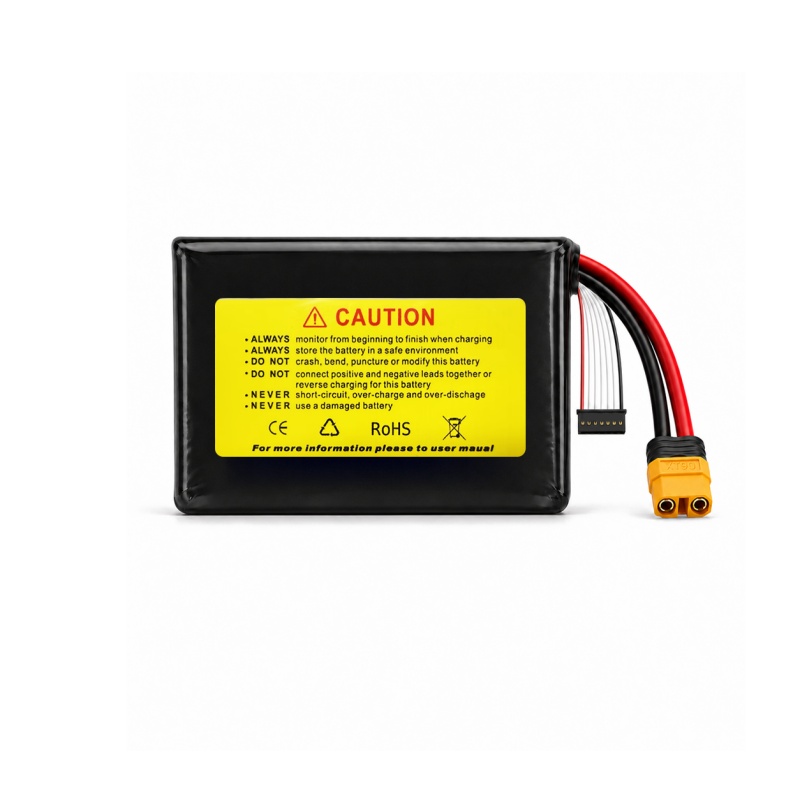
Battery Packing Label
The following warnings should be indicated on the battery pack labels.
- Use a specified charger.
- Do not throw the battery into fire, or heat.
- Do not short-circuit the battery terminals.
- Do not disassemble the battery.
Common Application Scenarios









Lorem ipsum dolor sit amet
Related Products
Product FAQs
1. What are the typical applications of lithium-ion batteries?
Lithium-ion batteries are widely used in various industries, including consumer electronics, renewable energy systems, medical devices, and industrial equipment. Their high energy density, long cycle life, and lightweight properties make them ideal for powering a wide range of applications.
2. How do I choose the right lithium-ion battery for my project?
Choosing the right lithium-ion battery depends on factors like voltage, capacity, discharge rate, and environmental conditions. Our team of experts can assist you in selecting the optimal battery based on your specific needs and application requirements.
3. What are the benefits of using lithium-ion batteries for industrial applications?
Lithium-ion batteries offer numerous benefits for industrial applications, including high energy density, long-lasting performance, fast charging, low maintenance costs, and compact size. These features improve efficiency and reduce overall operational costs in industrial settings.
4. What warranty do you offer on lithium-ion batteries?
PKNERGY offers a standard warranty on all lithium-ion batteries, typically covering manufacturing defects and performance issues. The specific warranty terms may vary depending on the battery model and application. Please contact us for detailed warranty information for your selected product.