
TABLE OF CONTENTS
Semi-Solid-State vs.
Lithium Drone Batteries: Which Is Better?
For drone manufacturers and UAV operators, battery performance directly affects flight endurance, payload capacity, and operational efficiency. As drones are increasingly used in aerial mapping, industrial inspection, agriculture, and cargo delivery, the demand for lighter batteries with higher energy density continues to grow.
This has brought semi-solid-state lithium battery technology into the spotlight. With its potential for higher energy density and improved electrolyte stability, it is becoming an interesting option for next-generation UAV power systems. But what actually makes semi-solid-state batteries different from conventional lithium batteries? And are they really better for drone applications?
As a battery manufacturer specializing in UAV and custom lithium battery solutions, PKNERGY offers semi-solid-state drone batteries with energy density specifications of up to 450Wh/kg, alongside cylindrical, high-voltage pouch, and high-rate UAV battery solutions. In this article, we’ll explore the key differences, performance characteristics, and practical applications to help you understand which battery technology may be more suitable for your drone.
01. What Makes Semi-Solid-State Batteries Different?
The main difference between semi-solid-state batteries and conventional lithium-ion batteries lies in their electrolyte composition and internal cell structure.
Traditional lithium-ion batteries generally use liquid electrolytes to transport lithium ions between the positive and negative electrodes. Semi-solid-state batteries, on the other hand, incorporate solid or gel-like electrolyte components into their internal structure, reducing reliance on conventional free-flowing liquid electrolytes.
This hybrid approach aims to combine the established manufacturing advantages of lithium-ion technology with some of the potential benefits of solid-state materials. Depending on the chemistry and cell design, semi-solid-state batteries may offer higher energy density and improvements in electrolyte stability.
It is important to distinguish semi-solid-state batteries from all-solid-state batteries. Semi-solid-state cells may still contain a certain amount of liquid electrolyte, while all-solid-state batteries are designed to use solid electrolytes throughout. Therefore, semi-solid-state technology should not be described as completely liquid-free.
For UAV manufacturers, this technology represents an alternative development direction for high-energy-density lithium batteries, particularly where reducing battery weight and increasing onboard energy are important design objectives.
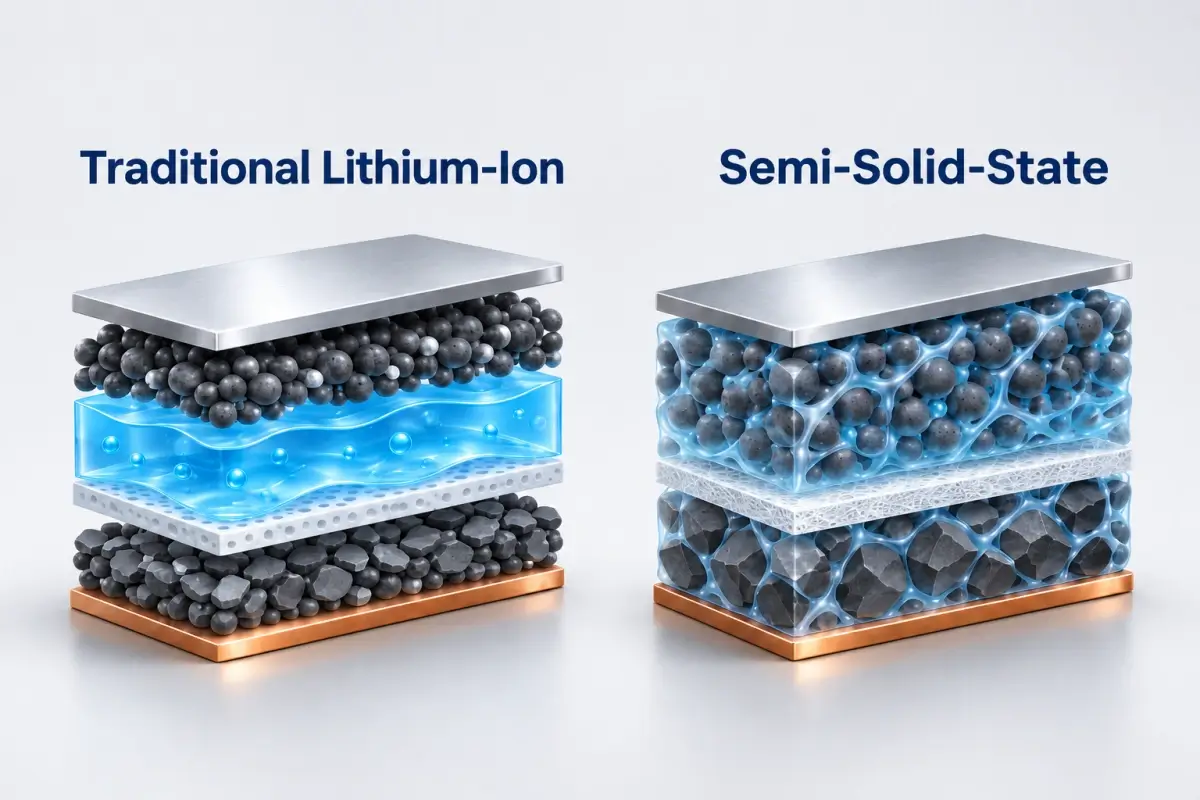
Structural comparison of conventional lithium-ion and semi-solid-state battery technologies.
02. Higher Energy Density for Longer Drone Flight Endurance
Energy density is one of the most important specifications when selecting a drone battery. Usually measured in watt-hours per kilogram (Wh/kg), it indicates how much energy a battery can store relative to its weight.
For UAV applications, battery weight directly influences aircraft performance. A heavier battery increases takeoff weight and may require more power from the propulsion system. This can reduce available payload capacity or limit flight endurance.
A high energy density drone battery can store more energy within a similar weight range. This makes semi-solid-state lithium battery technology particularly interesting for long-endurance UAVs used in aerial mapping, surveying, industrial inspection, and agricultural operations.
PKNERGY’s semi-solid-state UAV battery solutions are developed with high energy density and lightweight integration in mind. Selected product specifications reach up to 450Wh/kg, offering drone manufacturers an option when seeking to increase onboard energy without unnecessarily increasing battery weight.
For example, PKNERGY offers a 14.8V 36Ah semi-solid-state UAV battery configuration with a 4S1P structure. This configuration is designed for mid-sized multirotor platforms where energy capacity, battery weight, and flight endurance are important considerations.
However, higher energy density does not automatically translate into a fixed increase in flight time. Actual endurance also depends on aircraft weight, motor efficiency, propeller configuration, payload, flight conditions, and battery discharge characteristics.
03. Electrolyte Stability and Battery Safety
Battery safety is another important consideration for commercial and industrial drones. UAV batteries are exposed to vibration, changing operating temperatures, repeated charging cycles, and demanding discharge conditions.
Conventional lithium-ion batteries use liquid electrolytes, which are generally flammable. Under abnormal conditions such as internal short circuits, overcharging, or severe mechanical damage, a battery may experience thermal runaway.
Semi-solid-state technology aims to improve electrolyte stability by incorporating solid or gel-like components. Depending on the specific chemistry and cell construction, this approach may help reduce certain electrolyte-related risks and improve thermal behavior.
This is one reason why semi-solid-state batteries are receiving attention in the UAV industry. For applications involving valuable payloads, industrial equipment, or extended operations, battery reliability is an important part of the overall power system.
At PKNERGY, semi-solid-state drone battery development focuses on combining high energy density with dependable battery pack integration. Cell selection, structural design, protection circuits, and application-specific testing all contribute to overall battery performance.
Nevertheless, semi-solid-state batteries are not risk-free. They still require appropriate battery management, charging protection, thermal management, mechanical protection, and compliance with relevant transportation and application standards.
04. Energy Density vs. Discharge Rate: What Matters More?
Higher energy density is valuable, but it is not the only factor that determines whether a battery is suitable for a drone. Discharge rate, often expressed as a C-rate, is equally important for UAV propulsion systems.
A battery with a high C-rate can deliver current more quickly relative to its capacity. This is particularly important for FPV racing drones, aggressive flight maneuvers, rapid acceleration, and applications requiring high instantaneous power.
In contrast, long-endurance UAVs used for mapping, aerial photography, surveying, and inspection may prioritize energy density and consistent power delivery over extreme burst discharge capability.
For example, PKNERGY’s referenced 14.8V 36Ah semi-solid-state battery configuration has a specified 2C discharge rate. It is positioned for applications where energy capacity and endurance are important considerations rather than extreme racing-level current demands.
This is why choosing the right drone battery should start with the aircraft’s power requirements. A high-energy-density semi-solid-state battery may be suitable for an endurance-focused UAV, while a high-rate LiPo battery may remain more appropriate for a racing drone.
05. Semi-Solid-State vs. Traditional Lithium Batteries: Key Differences
So, which battery technology is better for drones? The answer depends on the aircraft’s mission, power requirements, and design priorities. The following comparison highlights several important factors for UAV battery selection.
| Comparison | Traditional Lithium Battery | Semi-Solid-State Battery |
|---|---|---|
| Electrolyte | Primarily liquid electrolyte | Hybrid solid-liquid or gel-like system |
| Energy Density | Depends on cell chemistry and design | Potential for higher energy density |
| Electrolyte Stability | Uses conventional liquid electrolyte | Designed to improve electrolyte stability |
| Flight Endurance | Depends on capacity and battery weight | Potential advantage for endurance-focused UAVs |
| Discharge Rate | High-rate LiPo models are widely available | Depends on cell design and validated C-rate |
| Typical UAV Applications | FPV, industrial drones, and general UAVs | Long-endurance, mapping, inspection, and specialized UAVs |
The comparison shows that semi-solid-state technology is not necessarily a universal replacement for traditional lithium batteries. Instead, it provides another option for UAV manufacturers looking to optimize energy density, battery weight, and application-specific performance.
06. Which Drone Applications Can Benefit from Semi-Solid-State Batteries?
Not every drone requires the same battery characteristics. The choice between semi-solid-state, lithium-ion, and high-rate lithium-polymer batteries depends on the aircraft’s mission, payload, flight profile, and power consumption.
Long-Endurance Mapping and Surveying Drones
Mapping and surveying UAVs often operate over large areas and require consistent power throughout extended missions. A lightweight, high-energy-density drone battery can help improve flight efficiency while maintaining sufficient energy for onboard cameras, positioning systems, and other equipment.
Industrial Inspection and Aerial Photography
Inspection drones used for infrastructure, power lines, industrial facilities, and construction sites may benefit from battery configurations that balance flight endurance and payload requirements. Semi-solid-state UAV batteries can be considered when reducing battery weight and increasing onboard energy are key design objectives.
Agricultural and Cargo Drones
Agricultural spraying and cargo UAVs often carry substantial payloads, making battery weight and power output especially important. However, these applications can also demand high discharge currents. Battery selection should therefore consider both continuous and peak current requirements instead of focusing on energy density alone.
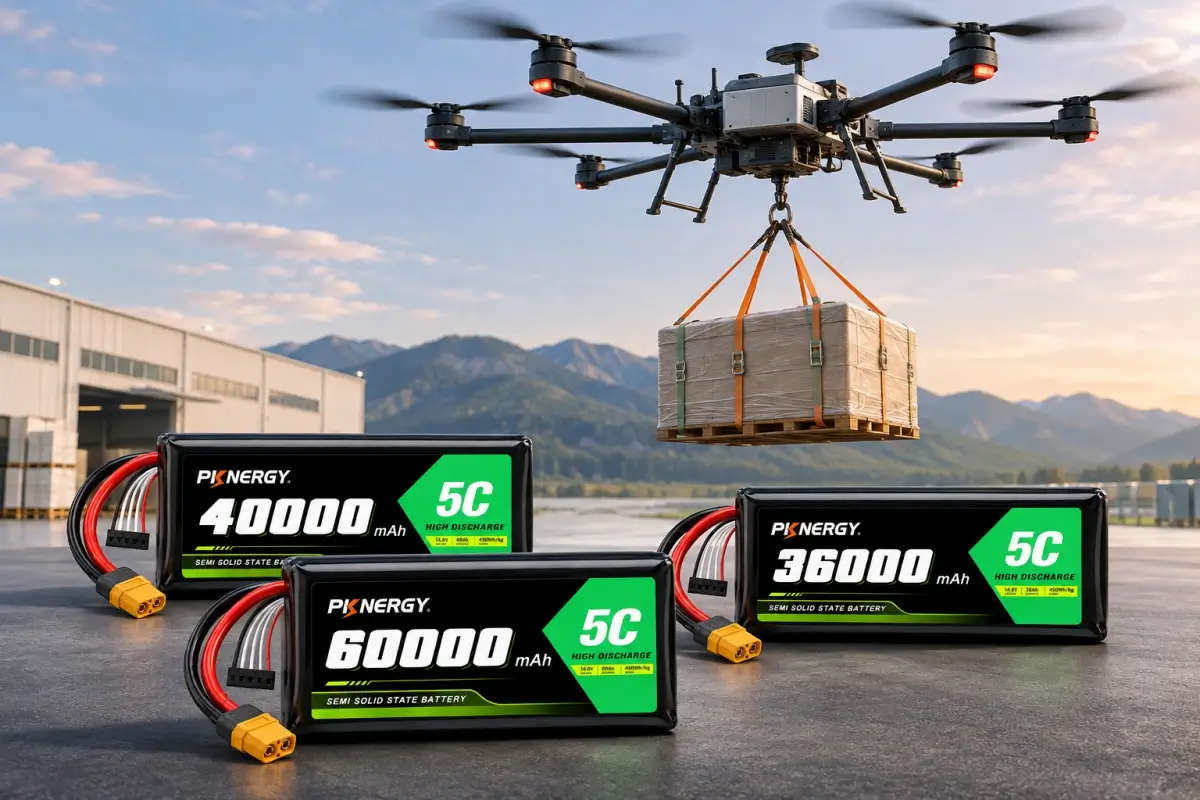
Semi-solid-state battery applications in industrial UAVs and long-endurance drones.
07. PKNERGY Semi-Solid-State UAV Battery Solutions
As drone platforms become more specialized, battery selection increasingly requires more than simply matching voltage and capacity. Weight limitations, flight duration, discharge current, installation space, and connector requirements all influence the final battery configuration.
PKNERGY develops custom lithium battery solutions for UAV and drone applications, including semi-solid-state, cylindrical, high-voltage pouch, and high-rate pouch battery configurations.
For projects that prioritize lightweight construction and high energy density, PKNERGY’s semi-solid-state drone battery solutions provide an additional option for next-generation UAV power systems.
PKNERGY Semi-Solid-State UAV Battery | Product Highlights
- Cell Model: 10975175GSH2
- Nominal Voltage: 14.8V
- Rated Capacity: 36Ah
- Battery Configuration: 4S1P
- Specified Energy Density: Up to 450Wh/kg
- Discharge Rate: 2C
- Weight: Approximately 1,150g
- Dimensions: 45.5 × 78 × 195mm
Beyond standard battery configurations, PKNERGY can work with UAV manufacturers to evaluate custom voltage, capacity, dimensions, discharge performance, and battery pack integration requirements. Whether the project involves a long-endurance inspection drone, an industrial multirotor, or a specialized aerial platform, selecting the right battery architecture is essential.
PKNERGY’s broader UAV battery portfolio also includes
cylindrical UAV batteries,
high-voltage pouch UAV batteries,
high-rate pouch batteries,
and
ultra-high-rate racing drone batteries.
This allows different drone platforms to be evaluated according to their actual power demands rather than relying on a one-size-fits-all battery solution.
08. Are Semi-Solid-State Drone Batteries Worth Considering?
Semi-solid-state drone batteries are attracting attention because they offer a promising balance between high energy density, electrolyte stability, and practical battery design. For UAV platforms that prioritize longer flight endurance and lightweight power systems, they are certainly worth evaluating.
However, the best drone battery is not always the one with the highest energy density. Discharge rate, operating temperature, cycle life, battery management, and aircraft compatibility all matter.
The right approach is to select a battery based on the actual mission requirements of the UAV. With a range of semi-solid-state and conventional lithium battery solutions, PKNERGY supports drone manufacturers in exploring suitable power configurations for different applications.
Looking for a High Energy Density Drone Battery?
Discuss your UAV battery requirements with PKNERGY. From semi-solid-state battery technology to custom lithium battery packs, we can help you explore a suitable solution for your drone platform.