
Table of Contents
-
01The Battery: The Energy Foundation of Every Electric UAV
-
02How Drone Batteries Enable System Startup and Takeoff
-
03How Battery Performance Affects Flight Stability
-
04The Impact of Batteries on Flight Time and Mission Capability
-
05Drone Battery Safety: Electrical, Thermal and Functional Reliability
-
06How Battery Requirements Differ Across UAV Applications
-
07Energy Density, Power Density and Weight: Key Performance Factors
-
08Understanding Drone Battery Specifications Through Engineering Calculations
-
09Choosing the Right Drone Battery for UAV Manufacturers
-
10Conclusion: Why Battery Performance Defines UAV Capability
Why Drone Batteries Are Critical to UAV Performance, Flight Stability, and Safety
Understanding how lithium battery technology influences UAV startup, propulsion, flight endurance, operational reliability, and mission performance.
A drone’s ability to take off, maintain stable flight, carry payloads, and complete demanding missions depends on much more than its motors or flight control system. At the foundation of these capabilities is its battery system. As the primary energy source of an electric unmanned aerial vehicle (UAV), the battery determines how much electrical power is available to the propulsion system, how long the aircraft can operate, and how reliably its onboard electronics function under changing flight conditions.
Modern UAVs rely on an interconnected combination of battery packs, electronic speed controllers (ESCs), brushless motors, flight controllers, sensors, navigation equipment, and communication systems. Each component performs a different function, but their electrical operations depend on a suitable and reliable power supply.
This makes the drone battery far more than an interchangeable power accessory. Its voltage, capacity, discharge capability, internal resistance, weight, thermal characteristics, and overall reliability directly influence the operational potential of the aircraft.
Understanding this relationship is essential for UAV manufacturers, drone developers, and battery procurement professionals. This article examines the role of drone batteries throughout the entire flight process, from initial system startup and takeoff to flight stability, endurance, safety, and mission execution.
The central engineering principle
A UAV’s flight controller determines how the aircraft should respond, its ESCs regulate motor operation, and its motors generate thrust. The battery supplies the electrical energy that makes these functions possible. Its performance therefore affects the entire aircraft, not just its flight duration.
1. The Battery: The Energy Foundation of Every Electric UAV
A typical electric multirotor drone operates through several interconnected electrical and mechanical systems. The battery stores electrical energy and supplies it to the power distribution system, which distributes electricity to the propulsion system and other onboard electronics.
The propulsion system generally consists of electronic speed controllers, brushless motors, and propellers. Meanwhile, the flight controller processes information from onboard sensors and sends commands to the ESCs to regulate motor speed and maintain the aircraft’s attitude.
How the Battery Connects Different UAV Systems
- Power Distribution: Delivers electrical energy from the battery to the propulsion system and onboard electronic components.
- Electronic Speed Controllers: Convert and regulate electrical power to control the speed and torque of brushless motors.
- Brushless Motors: Convert electrical energy into mechanical rotation to drive the propellers and generate thrust.
- Flight Controller: Processes sensor data and adjusts motor commands to maintain stable flight.
- Navigation and Communication: Support positioning, telemetry, remote control, and mission coordination.
- Payload Equipment: Cameras, LiDAR sensors, spraying systems, and other mission equipment require an appropriate power supply.
Although the battery does not directly control flight attitude, its ability to deliver sufficient electrical power is fundamental to the operation of these systems.
Why Battery Performance Affects the Entire Aircraft
A mismatch between battery characteristics and UAV power requirements can create limitations throughout the aircraft. For example, a battery with insufficient discharge capability may experience excessive voltage sag under heavy motor loads. This can reduce the available propulsion power or trigger low-voltage protection.
Similarly, insufficient energy capacity limits operating time, while excessive battery weight increases the thrust required to maintain flight. Battery selection should therefore be considered during the UAV design process rather than treated as a final accessory decision.
2. How Drone Batteries Enable System Startup and Takeoff
The first critical responsibility of a drone battery begins before the aircraft leaves the ground. It must provide reliable electrical power during system initialization, motor startup, and takeoff.
System Power-Up and Electrical Initialization
When a battery is connected, electrical power is supplied to the UAV’s power distribution architecture. Depending on the platform design, onboard electronics may receive power through dedicated regulators, DC-DC converters, or integrated power modules.
The flight controller, navigation system, communication equipment, and other electronic components must receive voltage within their specified operating ranges. An unsuitable battery voltage, poor electrical connections, or excessive voltage fluctuations can interfere with system initialization and normal operation.
Motor Startup and Takeoff Power Requirements
During takeoff, the propulsion system must generate sufficient thrust to overcome the combined weight of the aircraft, battery, and payload. The motors may require substantial electrical current, particularly when the aircraft accelerates or climbs rapidly.
For a multirotor UAV, the total thrust generated by its motors must exceed its weight to achieve upward acceleration. The required thrust margin depends on aircraft design, motor and propeller characteristics, and intended operating conditions.
This creates three important battery requirements:
- Appropriate Voltage: The battery’s nominal and operating voltage must match the electrical architecture of the ESCs and motors.
- Sufficient Discharge Capability: The battery must deliver the current required during takeoff and other high-load operating conditions.
- Controlled Internal Resistance: Excessive internal resistance increases voltage drop and heat generation under heavy loads.
Understanding Voltage Sag During High-Current Operation
One of the most important electrical characteristics during takeoff is voltage sag. When a battery supplies a high current, its terminal voltage decreases because of internal resistance and electrochemical polarization effects.
Simplified voltage-drop model under load.
Where:
- Vterminal: Battery terminal voltage under load.
- VOC: Open-circuit voltage.
- I: Discharge current.
- R: Effective internal resistance of the battery pack.
Engineering Example: Battery Voltage Drop
Assume a battery pack has an effective internal resistance of 5 mΩ and supplies 100 A during a high-load operating condition.
The battery experiences an estimated voltage drop of 0.5 V under this simplified resistive model.
In an actual UAV, voltage sag also depends on state of charge, temperature, cell polarization, wiring resistance, connectors, and transient load duration.
If voltage falls below the operating threshold of the ESC, flight controller power supply, or other electrical components, the aircraft may experience reduced propulsion performance or protective shutdowns. This is why battery performance under load is often more important than its open-circuit voltage alone.
3. How Battery Performance Affects Flight Stability
Flight stability is commonly associated with flight controllers, gyroscopes, accelerometers, and control algorithms. However, these systems depend on the propulsion system’s ability to respond to their commands.
The battery is therefore an important part of the physical power chain supporting flight stability. Its role is indirect but essential: it must supply sufficient power for the propulsion system to execute the flight controller’s commands.
1. Voltage Stability and Motor Performance
During flight, the electrical load on a drone changes continuously. Takeoff, climbing, hovering, acceleration, maneuvering, and wind compensation all create different power demands.
When a flight controller detects a change in aircraft attitude, it adjusts motor commands to generate the required corrective forces and moments. The battery must supply the corresponding electrical power while maintaining voltage within the operating limits of the propulsion system.
If the battery experiences excessive voltage sag, the available motor power may decrease. In severe cases, this can limit the aircraft’s ability to generate the required thrust.
2. Dynamic Power Delivery During Flight
Multirotor aircraft require rapidly changing motor outputs to maintain balance and respond to external disturbances. For example, when a drone encounters crosswinds, its flight controller adjusts individual motor speeds to generate corrective thrust and maintain the desired flight attitude.
The battery must support these changing electrical loads without excessive voltage drop or thermal stress.
- Continuous Discharge Capability: Determines how much current the battery can sustain under specified thermal and operating conditions.
- Peak Discharge Capability: Indicates whether the battery can support short-duration high-current demands.
- Internal Resistance: Influences voltage sag, electrical losses, and heat generation.
- Temperature Performance: Affects the battery’s ability to maintain power output under different environmental conditions.
3. Battery Weight, Center of Gravity, and Aircraft Balance
Battery weight is another important factor affecting flight stability and overall aircraft performance. The battery is often one of the heaviest individual components in an electric multirotor UAV. Its mass and installation position influence the aircraft’s center of gravity and overall weight distribution.
An unsuitable battery configuration may create:
- Changes in the aircraft’s center of gravity.
- Reduced payload capacity.
- Higher thrust requirements during hovering.
- Increased propulsion energy consumption.
- Greater demands on structural and mechanical design.
A battery with a larger capacity may provide more stored energy, but its additional weight can increase power consumption. This creates an engineering trade-off between energy capacity and total aircraft mass.
4. Battery Aging and Long-Term Flight Reliability
Battery performance changes over time because of charge-discharge cycling, storage conditions, temperature exposure, and other degradation mechanisms.
As a lithium-ion battery ages, its available capacity may decrease while internal resistance increases. This can reduce both flight endurance and the ability to deliver high current. Consequently, two batteries with identical nominal capacity ratings may deliver different real-world performance if their health conditions differ.
Engineering perspective
Flight stability is a system-level result. Flight control algorithms determine the required response, while the battery and propulsion system must provide sufficient electrical and mechanical capability to execute that response.
4. The Impact of Batteries on Flight Time and Mission Capability
Flight endurance is one of the most visible performance indicators of an electric UAV. However, battery capacity alone does not determine how long a drone can remain airborne.
Actual flight time depends on usable battery energy, average power consumption, aircraft weight, propulsion efficiency, aerodynamic performance, environmental conditions, and mission profile.
Understanding Battery Energy
The nominal energy stored in a battery can be estimated using its nominal voltage and rated capacity.
For example, a 22.2 V battery with a rated capacity of 10 Ah has a nominal energy of:
This represents nominal stored energy, not necessarily the energy available for an entire flight. Actual usable energy depends on discharge limits, temperature, battery condition, load profile, and the required safety reserve.
Estimating Theoretical Flight Time
Engineering Example: Estimated Flight Endurance
Assume an illustrative UAV battery system has the following characteristics:
- Nominal energy: 1,000 Wh
- Assumed usable energy: 80% of nominal energy
- Average aircraft power consumption: 2,000 W
First, calculate usable energy:
Then estimate flight time:
Estimated flight time: 24 minutes
This is an illustrative energy-balance calculation, not a flight-time guarantee. Actual endurance must account for takeoff, landing, changing loads, environmental conditions, reserve requirements, and battery discharge characteristics.
Why Actual Flight Time Can Differ From Theoretical Estimates
- Takeoff and Climbing: Higher thrust requirements increase power consumption.
- Payload Weight: Additional cargo, spraying equipment, or cameras increase the aircraft’s total weight.
- Wind Conditions: Headwinds and crosswinds can increase propulsion demands.
- Flight Profile: Hovering, aggressive maneuvering, and forward flight have different energy requirements.
- Battery Temperature: Low or high temperatures can affect available capacity and power delivery.
- Battery Health: Aging reduces available energy and may increase internal resistance.
A larger battery does not automatically produce proportionally longer flight time. Its additional mass can increase the energy required to keep the aircraft airborne. For UAV manufacturers, the objective should be to optimize usable energy, battery mass, propulsion efficiency, and mission requirements as a complete system.
5. Drone Battery Safety: Electrical, Thermal and Functional Reliability
Battery safety is one of the most important considerations in electric UAV design. Unlike many ground-based applications, a drone operates in an environment where an unexpected loss of propulsion power can immediately affect its ability to remain airborne.
Battery safety therefore involves more than preventing overheating or fire. It also requires reliable electrical performance throughout the flight mission.
1. Electrical Safety and Protection
Lithium battery packs must operate within defined voltage, current, and temperature limits. Electrical abnormalities can affect individual cells, the battery pack, and connected UAV components.
Important electrical safety considerations include:
- Overcharge Protection: Prevents cells from exceeding their specified charging voltage limits.
- Over-discharge Protection: Helps prevent excessive discharge that may damage cells.
- Overcurrent Protection: Protects the battery and electrical system against excessive current.
- Short-Circuit Protection: Reduces the risk of dangerous current flow caused by electrical faults.
- Cell Voltage Monitoring: Helps identify cell imbalance and abnormal voltage conditions.
- Connection Reliability: Proper connectors, wiring, insulation, and mechanical fixation reduce electrical failure risks.
The protection architecture should be designed according to the battery chemistry, cell configuration, discharge requirements, and UAV electrical system. Not every lightweight racing or FPV battery uses the same BMS architecture as an industrial UAV battery pack.
2. Thermal Safety and Heat Management
Battery cells generate heat during charging and discharging. Under high-current operating conditions, internal resistance contributes to heat generation.
A simplified resistive heat-generation relationship is:
Where:
- Q: Heat energy generated by resistive losses.
- I: Current flowing through the battery.
- R: Effective electrical resistance.
- t: Duration of current flow.
Because resistive heating increases with the square of current, high-current operation can create substantial thermal stress. Battery design must therefore consider continuous discharge limits, peak current duration, cell temperature, cooling conditions, and the thermal characteristics of the enclosure.
3. Thermal Runaway and Cell-Level Safety
Thermal runaway is a serious battery failure condition in which internal heat generation accelerates and may lead to rapid temperature increases, venting, fire, or propagation to neighboring cells.
Factors that can contribute to battery thermal incidents include:
- Internal short circuits or physical cell damage.
- Overcharging or operation outside specified limits.
- Excessive current and abnormal temperature rise.
- Poor cell matching or inadequate pack protection.
- Improper mechanical design, vibration protection, or insulation.
Battery safety must be evaluated at both cell and pack levels. Cell chemistry is important, but the final safety performance also depends on pack construction, electrical protection, thermal management, manufacturing quality, and operating conditions.
4. Functional Safety: When Power Failure Becomes a Flight Risk
A battery-related failure does not always involve fire or visible physical damage. A battery may become unable to provide sufficient voltage or current even while appearing structurally intact.
Potential consequences include:
- Unexpected low-voltage warnings.
- Reduced propulsion capability.
- Premature mission termination.
- Insufficient energy for a safe return or landing.
- Loss of power to critical onboard equipment.
For professional UAV applications, reliable battery monitoring and appropriate return-to-home or emergency landing strategies are important parts of the overall aircraft safety architecture.
Safety is a system-level responsibility
A reliable drone battery must deliver the required power safely throughout its operating range. Cell quality, pack engineering, protection systems, manufacturing consistency, and aircraft-level monitoring all contribute to operational safety.
6. How Battery Requirements Differ Across UAV Applications
Not all drones have the same power requirements. A racing drone, agricultural spraying UAV, industrial inspection platform, and heavy-lift cargo drone operate under very different conditions.
The appropriate battery must be selected according to the aircraft’s propulsion system, payload, flight profile, electrical architecture, and mission objectives.
| UAV Application | Primary Battery Requirement | Key Engineering Consideration |
|---|---|---|
| Agricultural Spraying | High energy capacity and sustained power delivery | Payload weight, repeated flight cycles, and operating duration |
| Heavy-Lift and Cargo | High discharge capability and structural reliability | Takeoff current, payload mass, and voltage stability |
| FPV and Racing | High power output and rapid current response | Peak discharge, weight, and acceleration |
| Cinema and Aerial Photography | Balanced energy capacity and stable power | Flight duration, payload integration, and reliability |
| Inspection and Mapping | Consistent energy delivery and predictable endurance | Mission duration, sensor payloads, and return reserve |
Agricultural and Heavy-Lift UAVs
Agricultural spraying drones and heavy-lift UAVs often carry substantial payloads. Their propulsion systems must generate sufficient thrust to support both the aircraft and its operational load.
These applications may require batteries with higher capacity, strong continuous discharge capability, and suitable mechanical construction. High energy density can also be valuable because reducing battery mass may help preserve payload capacity and improve overall system efficiency.
FPV and Racing Drones
FPV racing drones prioritize rapid acceleration, maneuverability, and high power output. Their batteries must support demanding current loads while keeping overall aircraft weight low.
High-rate lithium polymer batteries are commonly used in this category because their designs can support high discharge requirements. However, the actual performance depends on cell chemistry, construction, temperature, and the specified discharge duration.
Cinema, Inspection, and Mapping UAVs
Professional photography, inspection, and mapping platforms often prioritize predictable flight endurance and reliable operation. Their batteries must support the propulsion system while also accommodating cameras, sensors, communication equipment, and other payload electronics.
For these platforms, the ideal battery is not necessarily the one with the highest discharge rate. A balanced combination of energy density, voltage stability, weight, and operating reliability is often more important.
7. Energy Density, Power Density and Weight: Key Performance Factors
Battery selection for UAV applications involves several competing engineering requirements. Two of the most important are energy density and power density. Although they are closely related, they describe different aspects of battery performance.
Energy Density: How Much Energy Can the Battery Store?
Gravimetric energy density describes the amount of energy stored per unit of mass, commonly expressed in watt-hours per kilogram (Wh/kg).
For UAV manufacturers, higher energy density can help increase available energy without a proportional increase in battery mass. This is particularly valuable for aircraft that require extended flight time or must carry heavy payloads.
Power Density: How Quickly Can the Battery Deliver Energy?
Power density describes how much power a battery can deliver relative to its mass, commonly expressed in watts per kilogram (W/kg).
A battery with high power capability can support demanding acceleration, takeoff, climbing, and maneuvering requirements. This is particularly important for racing, FPV, and heavy-lift platforms.
However, high power capability does not automatically mean high energy density. Battery design must balance energy storage, current delivery, thermal behavior, and weight.
| Performance Factor | Unit | Importance for UAVs |
|---|---|---|
| Energy Density | Wh/kg | Influences stored energy relative to battery mass. |
| Power Density | W/kg | Indicates power delivery capability relative to mass. |
| Internal Resistance | mΩ | Affects voltage sag and resistive heat generation. |
| Discharge Rate | C | Relates current capability to rated capacity. |
| Cycle Life | Cycles | Indicates durability under defined test conditions. |
Battery Chemistry and Structural Design
Different lithium battery technologies offer different performance characteristics. The appropriate choice depends on the UAV’s electrical requirements, weight limits, operating environment, and expected mission duration.
- Semi-Solid-State Lithium Batteries: Designed for high energy density and applications where reducing battery mass while maintaining useful power capability is important. Actual performance depends on cell design and the complete battery pack configuration.
- Cylindrical Lithium-Ion Batteries: Offer standardized cell formats and flexible pack configurations. They can be engineered for different voltage, capacity, and current requirements.
- High-Rate Lithium Polymer Batteries: Commonly used in applications that require strong current delivery, fast response, and compact battery construction.
- High-Voltage Pouch Batteries: Can be configured for higher-voltage UAV power systems, helping meet specific propulsion and electrical architecture requirements.
No single battery chemistry or construction method is ideal for every UAV. A high-energy battery may be suitable for long-endurance missions, while a high-rate design may be more appropriate for short-duration, high-power applications.
8. Understanding Drone Battery Specifications Through Engineering Calculations
Battery specifications are more than numbers on a product datasheet. They describe how a battery is expected to perform under defined electrical and operating conditions. UAV engineers should understand how voltage, capacity, configuration, discharge rate, and energy density relate to actual aircraft requirements.
1. Voltage and Series Configuration
Lithium battery packs are commonly described by their series and parallel configuration. The series count determines nominal pack voltage, while the parallel count increases capacity and current capability according to the cell design.
For example, a conventional lithium-ion cell with a nominal voltage of 3.7 V can be arranged in a 4S configuration:
The actual fully charged voltage depends on the specific cell chemistry and its specified charge limit. Therefore, nominal voltage and maximum charging voltage should always be distinguished when matching a battery to an ESC or other electrical component.
2. Capacity and Energy Calculation
Capacity is usually expressed in ampere-hours (Ah) or milliampere-hours (mAh). It indicates how much electric charge a battery can deliver under specified test conditions.
A 36 Ah battery configured at a nominal voltage of 14.8 V has a nominal energy of:
This calculation is useful for comparing battery energy, but it does not by itself establish flight time. The aircraft’s average power consumption and usable energy must also be considered.
3. Understanding the C-Rating and Discharge Current
The C-rating expresses discharge current relative to battery capacity. It is commonly used to describe the current capability of UAV batteries, particularly in applications requiring high power output.
For example, if a 36 Ah battery is rated for 2C continuous discharge:
This corresponds to a theoretical continuous current rating of 72 A, provided that the specific battery model is rated for this discharge condition.
Peak discharge ratings must be interpreted separately. A battery may support a higher current for a limited period without being suitable for continuous operation at that level. Temperature limits, voltage limits, and manufacturer test conditions must always be considered.
4. Energy Density and Battery Weight
Energy density can help engineers estimate how much nominal energy a battery provides relative to its mass.
For example, if a battery pack stores 600 Wh of energy and weighs 2 kg, its gravimetric energy density is:
When comparing energy density specifications, it is important to determine whether the figure refers to the cell or the complete battery pack. Pack-level energy density includes additional mass from connections, wiring, structural components, protection systems, and enclosure materials.
A practical specification rule
Voltage determines electrical compatibility, capacity and energy relate to endurance, C-rating relates to current capability, and energy density relates to energy stored per unit of mass. These specifications must be evaluated together rather than individually.
9. Choosing the Right Drone Battery for UAV Manufacturers
Selecting a drone battery is an engineering decision that should begin with the aircraft’s electrical and mission requirements. Choosing a battery based only on capacity or discharge rate can lead to an unsuitable design.
UAV manufacturers should evaluate several factors before confirming a battery configuration.
1. Electrical Compatibility
- Nominal and maximum operating voltage.
- Series and parallel configuration.
- ESC and motor voltage requirements.
- Connector type and current rating.
- Compatibility with onboard monitoring and protection systems.
2. Power and Discharge Requirements
- Continuous current demand during normal operation.
- Peak current demand during takeoff and acceleration.
- Expected duration of peak discharge events.
- Acceptable voltage sag under load.
- Thermal limits under the intended operating profile.
3. Energy and Flight Endurance
- Required mission duration.
- Average aircraft power consumption.
- Required usable energy and reserve capacity.
- Payload weight and total aircraft mass.
- Battery energy density and installation space.
4. Mechanical Design and Customization
A UAV battery must fit the aircraft’s physical structure and installation requirements. Custom battery engineering may involve more than changing capacity or voltage.
- Battery dimensions and mounting arrangement.
- Weight distribution and center-of-gravity requirements.
- Connector and cable configuration.
- Enclosure, insulation, and vibration protection.
- Thermal management and environmental requirements.
5. Battery Monitoring and Reliability
For professional UAV applications, battery monitoring can provide valuable information about voltage, current, temperature, state of charge, and battery condition. The appropriate monitoring architecture depends on the aircraft and battery design.
Manufacturers should also evaluate cell consistency, production quality, traceability, protection design, and validation under representative operating conditions.
PKNERGY UAV Battery Solutions
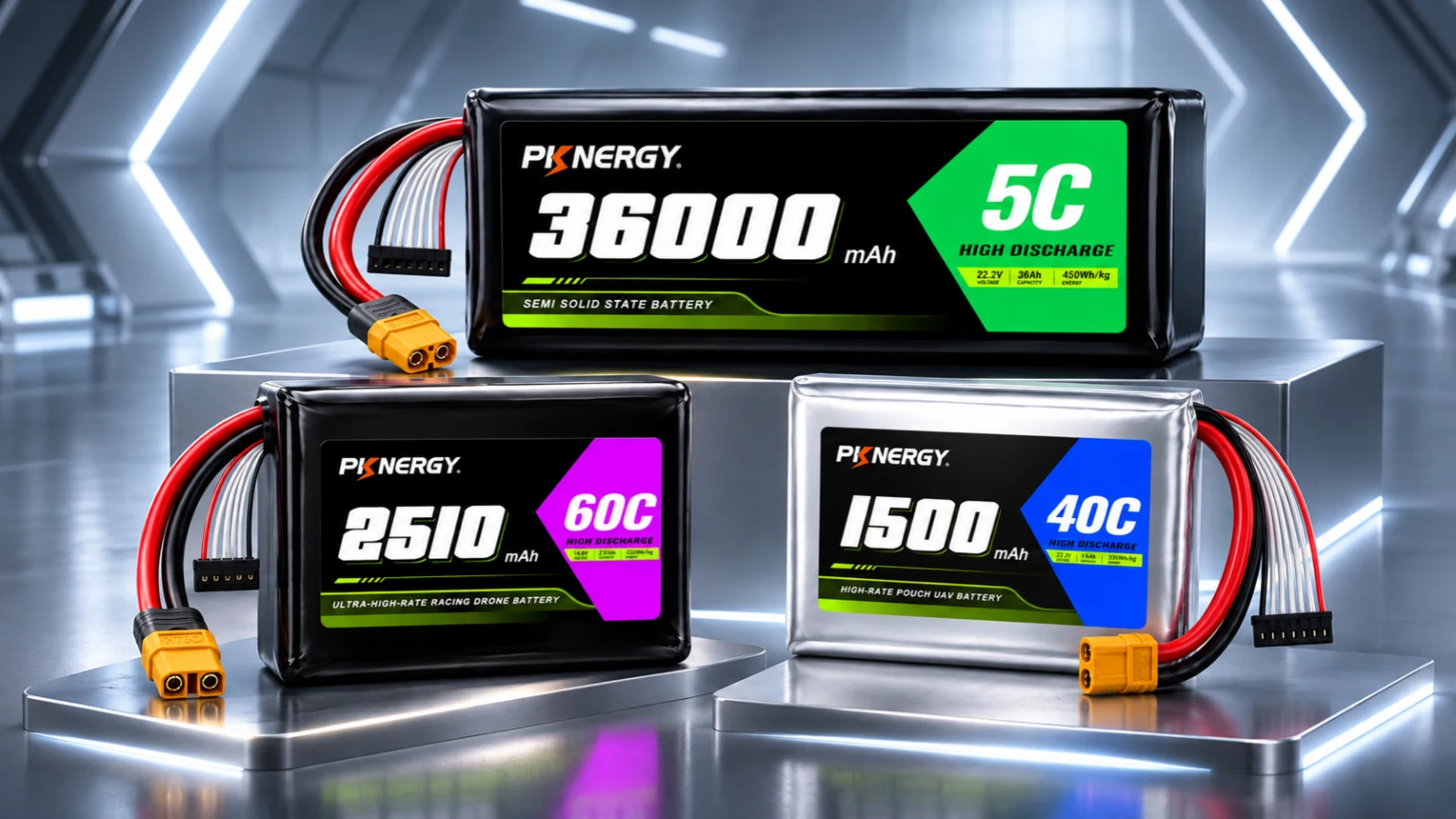
Different UAV platforms require different combinations of energy density, power output, voltage, capacity, and battery structure. PKNERGY’s UAV battery portfolio covers several lithium battery configurations designed for different application requirements.
Different UAV platforms require different combinations of energy density, power output, voltage, capacity, and battery structure. PKNERGY’s UAV battery portfolio covers several lithium battery configurations designed for different application requirements.
Semi-Solid-State UAV Batteries
Designed for UAV applications where high energy density and reduced battery mass are important considerations, including agricultural spraying, heavy-lift, and other demanding missions.
- Reported energy density: up to 450 Wh/kg.
- Capacity range: 36–60 Ah.
- Voltage range: 14.8–51.8 V.
- Published series specifications include 2C continuous discharge and 2.5–5C short-duration discharge for up to 15 seconds, subject to the specific model.
Energy-density figures should be identified as cell-level or pack-level values in the applicable product datasheet.
Cylindrical UAV Batteries
Cylindrical lithium-ion cell configurations offer flexible battery pack engineering for UAV platforms with defined voltage, capacity, structural, and discharge requirements.
- Flexible series and parallel configurations.
- Custom voltage and capacity combinations.
- Pack design according to aircraft dimensions and installation requirements.
- Suitable for application-specific UAV power systems.
High-Voltage Pouch UAV Batteries
High-voltage pouch battery configurations are developed for UAV platforms requiring higher operating voltages and application-specific power delivery.
- Voltage range: 15.2–53.9 V.
- Capacity range: 8,000–16,000 mAh.
- Designed for high-voltage UAV power architectures.
- Configuration and discharge capability depend on the selected model.
High-Rate Pouch UAV Batteries
High-rate pouch batteries are intended for UAV systems that require strong current delivery in compact and lightweight configurations.
- Voltage options: 14.8 V and 22.2 V.
- Capacity range: 1,500–5,000 mAh.
- Application focus: high-power UAV propulsion requirements.
- Discharge performance varies by model and operating conditions.
Racing UAV Batteries
Designed for FPV racing and other applications where rapid power delivery, acceleration, and low battery weight are key priorities.
- Published discharge rating: up to 90C for applicable models.
- Voltage options: 14.8 V and 22.2 V.
- Capacity range: 5,000–8,000 mAh.
- Designed for high-rate FPV and racing applications.
The specifications above describe representative product ranges and published series capabilities. Actual voltage, capacity, discharge limits, weight, dimensions, and energy density should be confirmed against the datasheet of the selected battery model.
For UAV manufacturers developing a new aircraft or upgrading an existing platform, battery customization should begin with the electrical load profile, required flight time, available installation space, and target operating environment.
10. Conclusion: Why Battery Performance Defines UAV Capability
The drone battery is one of the most influential components in an electric UAV. It supplies the energy required for system startup, supports propulsion during takeoff and flight, and provides the electrical foundation for navigation, communication, payload operation, and other onboard functions.
Its characteristics influence flight endurance, power delivery, voltage stability, aircraft weight, thermal behavior, and operational reliability. A battery that cannot meet the aircraft’s current demands may limit propulsion performance, while an unsuitable energy-to-weight balance can reduce payload capacity and mission duration.
For this reason, choosing a drone battery should never be reduced to selecting the highest capacity or discharge rating. The right solution is the one that delivers the required energy and power within the aircraft’s electrical, mechanical, thermal, and safety constraints.
The Right Battery Is a System-Level Engineering Decision
- The correct voltage ensures compatibility with the UAV power system.
- Adequate discharge capability supports takeoff and dynamic flight loads.
- Sufficient usable energy helps achieve the required mission duration.
- Optimized energy density helps balance battery mass and payload capacity.
- Reliable protection and thermal design support safe operation.
- Consistent manufacturing and validation help maintain long-term reliability.
As UAV technology continues to evolve toward longer endurance, heavier payloads, higher operating voltages, and more demanding flight profiles, battery engineering will remain central to aircraft development. For UAV manufacturers, working with a battery supplier that understands application requirements, electrical performance, and custom pack design can make an important difference in achieving a reliable and well-balanced aircraft.
Looking for a Custom Drone Battery Solution?
PKNERGY provides lithium battery solutions for different UAV requirements, including semi-solid-state, cylindrical, high-voltage pouch, high-rate pouch, and racing battery configurations.
Share your UAV voltage, capacity, continuous and peak current requirements, available installation space, and target flight time. Our team can help evaluate a suitable battery configuration for your application.